

K-startups capturing the Middle East with blockchain technology
Summary
- It reported that demand for authentication technology and blockchain-based trust certification is rapidly increasing in the Middle East.
- It said Korean startups are showcasing AI and blockchain-converged services, attracting interest from local buyers.
- The local market values trust in contracts and transactions, and noted that sustained support capability and compliance with local certification systems are important factors for investment.
Korea startup pavilion bustling all day
Demand for 'authentication technology' surges in the Middle East
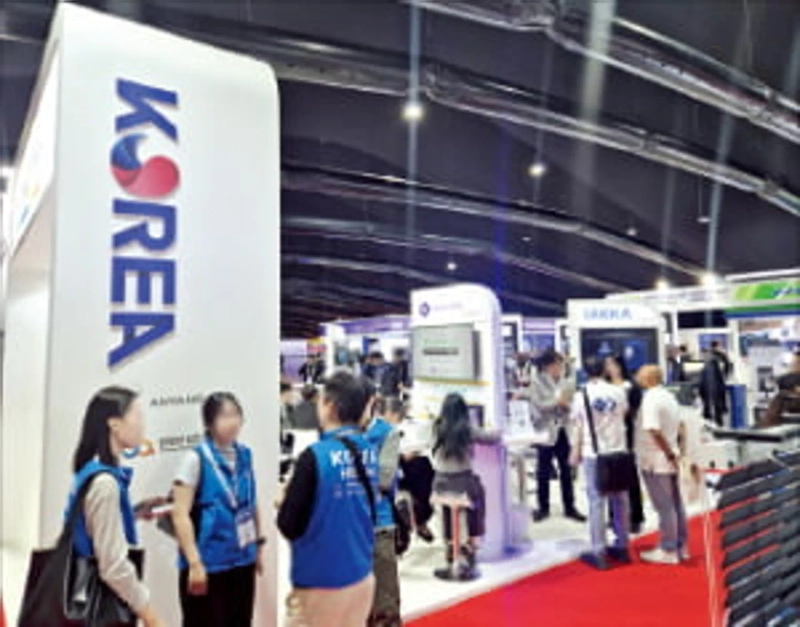
On the 13th at the 'Expand North Star' startup pavilion in Dubai, United Arab Emirates (UAE). Standing on the main hall stairs, the first thing visible was the sign for Korea's blockchain zone. It was not yet 10 a.m., but the 'Korea Pavilion' (Korea Pavilion·photo), where Korean startups' technologies from artificial intelligence (AI), healthcare, and mobility to blockchain were gathered, was packed. The enthusiasm for Korean technology was so high that one of the ten exhibition halls was allocated entirely to the Korea Pavilion.
This year the Korea Pavilion included participation by 15 organizations such as KOTRA, the National IT Industry Promotion Agency (NIPA), and the Korea Internet & Security Agency (KISA), supporting about 100 companies. The scale is more than 30% larger than last year. A KISA official on site said, "As the Middle East speeds up AI infrastructure expansion, interest in Korean technology is growing."
What drew the most attention were AI startups. Local buyers showed strong interest in AI application technologies such as data analysis, customer-tailored services, and content generation. An official said, "Consultations focused on areas that can be commercialized in practice, such as AI healthcare, AI content, and AI mobility." Rather than simple exhibitions, pre-matched investor presentation (IR) pitch sessions and impromptu one-on-one meetings were held throughout the afternoon.
The Korea blockchain zone also remained busy that day. Regional startups from Busan, Incheon, and other areas participated in large numbers, showcasing everyday blockchain technologies such as food provenance management, privacy protection, and B2B wallet infrastructure. Andami, CEO of FutureSense, a blockchain-based food supply chain tracking system company, said, "There are many inquiries to manage supply chain data transparently because religious and certification standards like halal and hygiene are stringent," adding, "Demand for 'trust certification' is rapidly increasing across the Islamic world and the Middle East, with moves such as Indonesia recently pushing for mandatory halal certification." A local accelerator official evaluated, "Korean startups are strong not only in technology but also in execution," and "AI and blockchain convergence services also fit well with the Middle East's 'trust economy' (trust economy)."
However, companies that have entered the local market commonly explain that 'Middle Eastern-style contracts' place more value on trust than on speed. An AI company representative participating in the event said, "Once trust is built, the transaction sizes are large," noting, "Local clients tend to scrutinize sustained support capabilities and local certification systems carefully."
Dubai=Ahn Jeong-hun, reporter ajh6321@hankyung.com

Korea Economic Daily
hankyung@bloomingbit.ioThe Korea Economic Daily Global is a digital media where latest news on Korean companies, industries, and financial markets.