

Another 'TACO' amid market shock…Trump softens toward China after two days
Summary
- President Trump signaled a conciliatory stance in response to concerns about a renewed U.S.-China tariff war, saying he left room for negotiations.
- China indicated a relatively hardline response, suggesting possible export controls on core materials including rare earths, lithium, and synthetic diamonds.
- Following President Trump's conciliatory gesture, New York markets saw S&P500 futures and Nasdaq-100 futures rebound.
Will the pattern of 'threat → backlash → retreat' repeat this time?
U.S. moves to calm markets as financial markets wobble
Trump: "I don't want China to be in a recession"
100% additional tariffs, leaves room for negotiations
China likely to continue hardline stance
"Preparing to curb exports of lithium and diamonds too"
Raising bargaining power before APEC summit
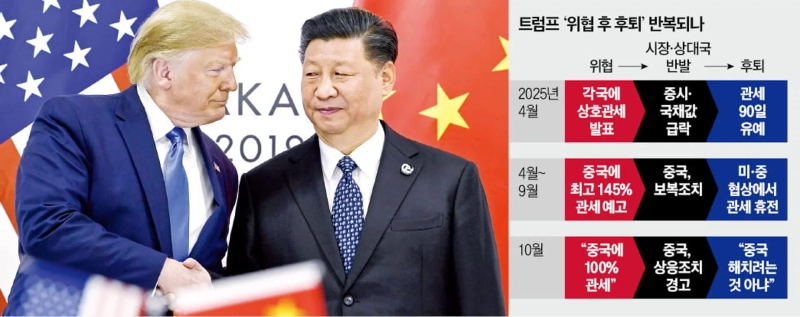
Donald Trump, the U.S. president, said on the 12th (local time), "President Xi Jinping of China does not want a recession, and neither do I." This marked a step back from his tough stance two days earlier when he said he would "impose 100% tariffs on China." The remark came shortly after financial markets tumbled amid renewed fears of a U.S.-China tariff war.
◇The U.S. faces the burden of breaking the deal
President Trump wrote on social media that in light of heightened concerns about a renewed U.S.-China tariff war, "the United States is not trying to hurt China but to help." He added, "Don't worry about China," and said, "Everything will be fine." He also said, "The very respected Chairman Xi has only had a brief bad moment," adding, "He does not want his country to suffer a recession and neither do I."
President Trump had threatened the day after China tightened controls on rare earth exports on the 9th, saying he would "impose 100% tariffs on Chinese goods starting November 1." In response, China said, "We do not seek a fight but are not afraid," and "If the U.S. insists, we will take corresponding measures." This raised concerns that the tariff truce between the two countries might collapse.
In this situation, President Trump made a conciliatory gesture. On his plane headed to Israel to seek an end to the Gaza war, Trump said, "I think we can do well with China," and "I have a good relationship with Chairman Xi." He also called Xi "a great leader of China." When asked by reporters whether he still planned to impose "an additional 100% tariff on China starting November 1," he answered, "For now, yes," but added, "Let's see what happens." He further commented, "November 1 feels like a very distant future to me," saying, "It may seem imminent to others, but it feels far away to me," suggesting there may be room for negotiation with China.
◇China, emboldened, takes a hard line
This has led to evaluations calling it another 'TACO' (Trump Always Chickens Out · Trump always backs down). The South China Morning Post (SCMP), citing a former U.S. official, said, "President Trump is a mega-TACO," and "Chairman Xi will see this clearly. It's a clear sign of weakness and lack of resolve." Market observers interpret that the financial market shock likely had an influence. Jamieson Greer, a U.S. Trade Representative (USTR) official, also said in a Fox News interview that "I believe the (financial) markets will stabilize next week," adding, "The tariffs have not yet been imposed." The U.S. New York stock market, which plunged late last week amid fears of a renewed tariff war, reacted with relief to President Trump's conciliatory gesture. Before the opening on the 13th, S&P 500 futures and Nasdaq-100 futures both rebounded.
There is also the view that President Trump considered the potential harm to U.S. consumers during the year-end period—Thanksgiving, Christmas, etc.—if a tariff war resumed, and that the success of negotiations hinges on whether China will buy U.S. soybeans. China has already threatened a 'soybean import ban' ahead of the fifth high-level U.S.-China trade talks scheduled for November in Frankfurt, Germany. If China's soybean import ban is not lifted, President Trump could be hurt in next year's midterm elections.
China is showing a relatively tougher stance. State-run Global Times editorialized on the 13th that "the difficulties currently facing China-U.S. trade are entirely the responsibility of the U.S. side." Hong Kong's Ming Pao reported that "China plans to implement export controls on advanced lithium-ion batteries and synthetic diamonds, following rare earths."
The Financial Times analyzed China's tightening of rare earth export controls as "an intentional move to induce a retaliatory measure from President Trump." Christopher Johnson, a former CIA China analyst, said, "In April, when President Trump expanded tariffs, Chairman Xi responded strongly and embarrassed (President Trump)," adding, "This time, Xi is similarly trying to induce an overreaction from the U.S. with the same strategy."
Experts see the current spat as moves by both leaders to strengthen their negotiating positions ahead of a potential U.S.-China meeting at the Asia-Pacific Economic Cooperation (APEC) summit to be held in Gyeongju, North Gyeongsang Province, at the end of this month. Bloomberg News forecasted that "U.S. and Chinese officials could meet as early as this week to continue negotiations."
Beijing=Eunjung Kim, correspondent / Donghyun Kim, reporter kej@hankyung.com

Korea Economic Daily
hankyung@bloomingbit.ioThe Korea Economic Daily Global is a digital media where latest news on Korean companies, industries, and financial markets.