

Advice from a Nobel laureate… "Korea should find a country to replace the U.S. on tariff issues"
Summary
- Professor Peter Howitt said that if the market is reduced by tariffs, incentives to innovate weaken.
- Howitt emphasized responding by securing new trading partners to replace the U.S. and bringing in external research and technical talent.
- He also stated that maintaining strong antitrust policies promotes new companies and innovation.
Peter Howitt, Brown University professor, 2025 Nobel Prize winner
13th: "If tariffs shrink the market, incentives to innovate weaken"
"Aging should be prepared for by opening up externally"
'Quickly find another trading partner that can replace the United States'
'Open Korea to external research personnel and technical talent to prepare for aging'
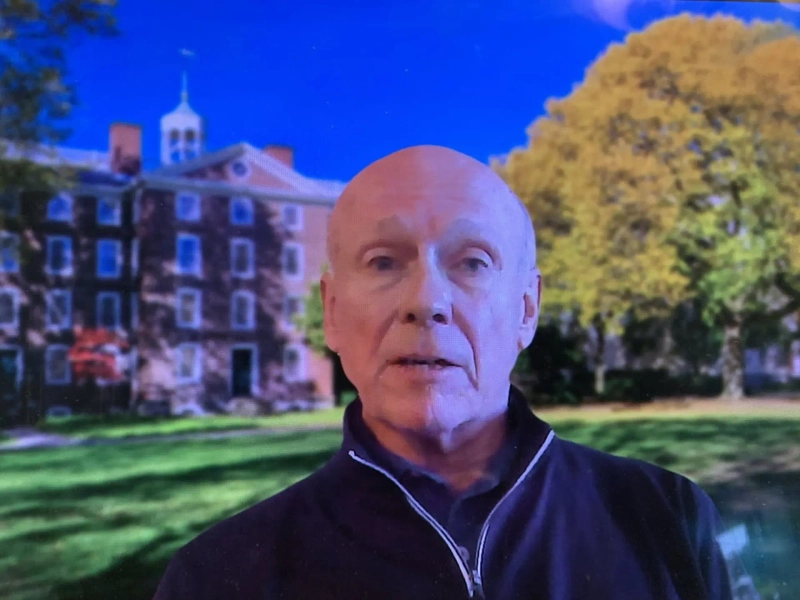
On the 13th (local time), Peter Howitt, a professor at Brown University in the United States who was announced as the Nobel Prize in Economic Sciences winner, presented these solutions for the Korean economy at a virtual press conference held that day.
Howitt shared the award with Joel Mokyr, a professor at Northwestern University in the United States, and Philippe Aghion, a professor at the Collège de France. In particular, Howitt was recognized for introducing the 'theory of sustainable growth through creative destruction' together with Aghion. In a paper they jointly published in 1992, they mathematically formalized economist Joseph Schumpeter's 'creative destruction.'
At the conference, Howitt offered several pieces of advice regarding the Korean economy. When asked about Korea's response to the Trump administration's tariff policy, he said, "If a particular partner retreats from trade, you must find other partners to maintain the market," adding, "If the market narrows, expected returns from R&D fall and incentives to innovate weaken."
He explained that the reason for urgently seeking other trading partners is that "international trade itself is an important channel for technology transfer," and "the more you trade with the world, the faster and more you can learn proven technologies." He meant that channels to inherit technological innovation must be maintained.
He also mentioned Korea's aging population. Howitt said, "Innovation tends to come more easily from younger people," and "aging is generally not conducive to innovation."
He proposed maintaining openness as a solution. Howitt said, "Innovation does not necessarily come only from within one's own country," and "openness that does not block cross-border flows of ideas through academia and industry is key." He suggested complementing internal demographic constraints with 'inflows of external knowledge' by expanding university and research institute cooperation as well as △global R&D networks △immigration and research visas.
To revitalize the Korean economy, which has recently experienced growth stagnation, he emphasized the importance of maintaining strong antitrust policies. He explained that existing companies prevent new firms and innovators from entering the market.
Howitt said, "In the case of the United States, I think that in recent years too much monopolistic power has been allowed without regulation," and "As a result, in several industries there has been some suppressive effect on innovation and economic growth."
Howitt pointed out that this part differs from Schumpeter's 'creative destruction' that he studied. He said, "When Schumpeter first wrote about 'creative destruction,' he argued that the expectation that firms would gain monopolistic positions gives them incentives to innovate."
However, the model that Howitt and Aghion developed sees market monopoly as bringing an effect of avoiding competition. He said, "The more intense the competition, the more leading firms innovate to get ahead, but if it is easier to suppress competition, firms will choose that route."
Howitt said, "Therefore strong antitrust and competition policies are necessary," and "That gives market leaders incentives to continue innovating, and it is the same for countries like Korea that are already very successful."
New York=Park Shin-young, correspondent nyusos@hankyung.com

Korea Economic Daily
hankyung@bloomingbit.ioThe Korea Economic Daily Global is a digital media where latest news on Korean companies, industries, and financial markets.