

Summary
- It reported that as China escalated its maritime trade war against the United States to include South Korea, U.S. stocks and cryptocurrencies showed declines.
- AI-related stocks and tech stocks fell together, while the prices of safe-haven assets gold and silver continued to rise.
- Experts forecast that escalating U.S.-China tensions could increase stock market volatility, but there is also the possibility of negotiations.
At the open Nasdaq recovered somewhat from a 2% plunge
AI stocks also fell together and gold continued to rise
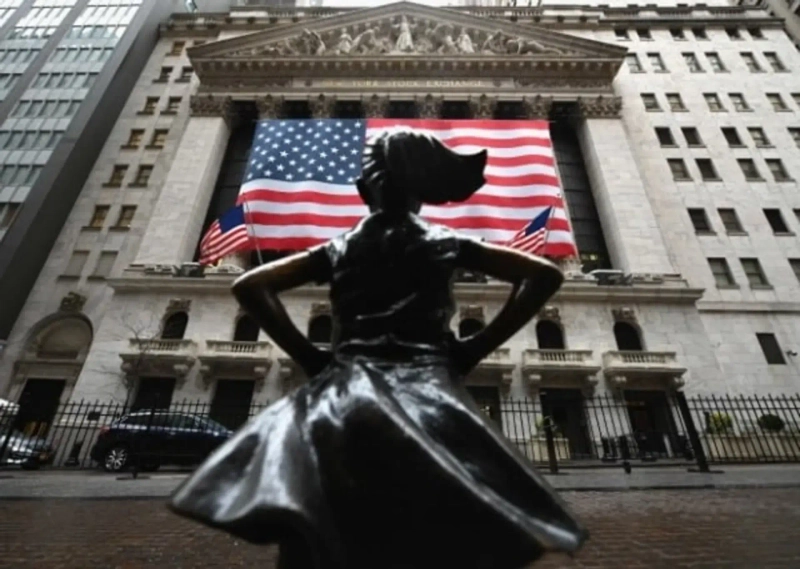
As China escalated its maritime trade war against the United States by involving South Korea, on the 14th (local time) U.S. stocks and cryptocurrencies fell while safe-haven assets such as gold and silver rose.
Around 10:20 a.m. EST, the S&P500 was down 0.7%, the Nasdaq down 1.1%, and the Dow Jones Industrial Average down 0.5%.
Compared with the open when the S&P500 fell 1.3% and the Nasdaq fell nearly 2%, the drops had somewhat recovered.
The CBOE volatility index VIX, known as Wall Street's fear gauge, exceeded 22 at the open, marking the highest level in four months. This surpassed last Friday's close when Trump mentioned a 100% tariff on China, suggesting renewed anxiety on Wall Street.
The 10-year Treasury yield was largely unchanged at 4.04%. Spot gold rose 0.3% to $4,121 per ounce, setting another record.
Bitcoin traded down 4.3% at $110,848, and Ether plunged 8.1% to $3,943.
AI-related stocks that had led the rally the previous day led the selling. Nvidia fell more than 3%, while Tesla and Oracle fell 2.5% and 1.4% respectively. Only AMD, which had signed another large contract with Oracle, showed gains of more than 1%.
China on that day sanctioned five U.S. subsidiaries of South Korea's shipbuilder Hanwha Ocean. The measure prevents Chinese institutions and individuals from dealing with the company. In response to U.S. port fees levied on Chinese ships, China also began imposing port fees on U.S.-built ships from that day.
This move targets South Korea's shipbuilding industry, which has promoted 'Masuga' (Make American shipbuilding great again), in the context of the U.S. rallying allied shipbuilders such as South Korea and Japan to revive its shipbuilding industry.
Ulrike Hofmann-Burchardi, head of global equities at UBS Global Wealth Management, said, "As U.S.-China tensions escalate rapidly, market volatility is expected to increase through the end of this month." However, she added, "Looking at the negotiation history between President Trump and President Xi Jinping, escalations often lead to tactical truces, and negotiations over rare earth mineral prices versus shipping fees will eventually be resolved."
Consumer goods maker Johnson & Johnson and major banks JPMorgan Chase, Wells Fargo, Goldman Sachs, and Citibank, which released earnings before the market opened that day, all reported results exceeding expectations.
Kim Jeong-a guest reporter kja@hankyung.com

Korea Economic Daily
hankyung@bloomingbit.ioThe Korea Economic Daily Global is a digital media where latest news on Korean companies, industries, and financial markets.