

Targeting China, 'Hardline vs Conciliatory' Messages…What Explains Trump's Flip-Flopping [Lee Sang-eun's Washington Now]
Summary
- Reported that President Trump toggled between hardline and conciliatory messages toward China, increasing concerns that the U.S.-China trade conflict will persist.
- Stated that due to this uncertainty, the S&P500 index and the Nasdaq index closed down.
- Said that while the U.S. and Chinese leaders are leaving room for talks, whether a summit will take place remains uncertain.
The hardline message is for domestic politics
Mentioned "stopping cooking oil imports" to placate soybean farmers
The conciliatory message targets President Xi
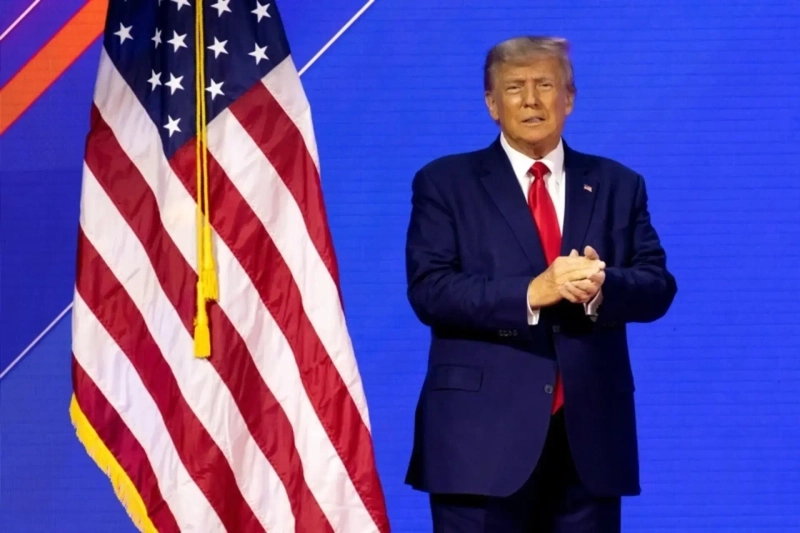
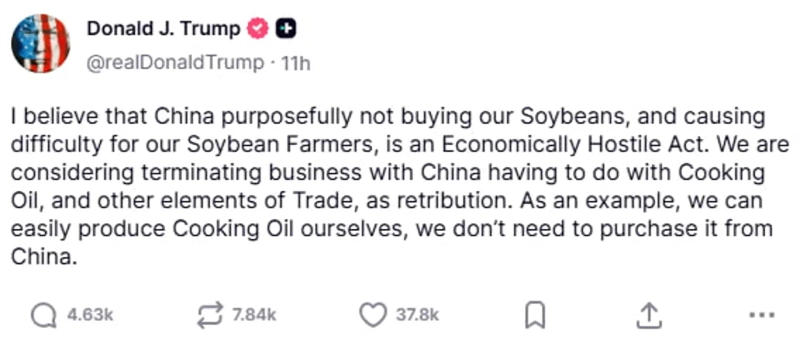
U.S. President Donald Trump warned on the 14th (local time) that China not buying U.S. soybeans is an 'economic act of hostility' and that he may no longer buy cooking oil from China.
President Trump wrote on social media that "he believes China is deliberately not buying our soybeans and is causing hardship for our soybean farmers," and "as retaliation, we are stopping cooking oil transactions with China and are considering other trade measures." He added, "We can easily produce cooking oil ourselves. We don't need to buy it from China."
Last week, after announcing 100% additional tariffs on China in response to China's policy to strengthen controls on rare earth exports, President Trump — who had returned to reconciliation mode saying "I'm not trying to hurt China but to help it" — took a hard line again in just two days. As a result of this remark, concerns grew that U.S.-China tensions would persist, and the S&P500 index (-0.16%) and the Nasdaq index (-0.76%) closed down that day.
The U.S. buys waste cooking oil from China and uses it for biodiesel fuel. According to the U.S. Department of Agriculture, the United States imported 1.27 million t of Chinese waste cooking oil last year. That is a 52% increase from the previous year. The U.S. bought 43% of China's total exports of waste cooking oil. Farmer groups such as the American Soybean Association argue that importing biodiesel fuel from abroad harms potential demand for soybean farmers.
Ahead of the scheduled U.S.-China summit, President Trump has been mixing conciliatory messages aimed at China with hardline messages for domestic politics. After meeting Argentine President Javier Milei at the White House that day, he said, "We have to be careful with China," while also saying, "China will not be able to take advantage of us." He added, "We have a fair relationship with China, and I think (U.S.-China relations) will be okay. If they are not okay, that is also fine." He also claimed, "We have inflicted and received a lot of blows, and it was very successful."
Whether the summit will take place is still uncertain. However, the more prevalent interpretation is that Trump's flip-flopping messages conceal a desire to make the summit happen. Jamieson Greer, a U.S. Trade Representative (USTR) official, said in an interview with CNBC that high-level U.S.-China officials met the previous day and that (President Trump) had set aside time for a leaders' summit. He also expressed confidence that he and Treasury Secretary Scott Bessent "think (the U.S.-China conflict) can be resolved."
China is also leaving the door open for dialogue. A spokesperson for China's Ministry of Commerce said on its website, "If we fight, we will fight to the end, and if we want to talk, the big door is wide open," adding, "China and the United States have broad common interests and vast space for cooperation, and cooperation benefits everyone while fighting hurts everyone."
Washington=Lee Sang-eun, correspondent selee@hankyung.com

Korea Economic Daily
hankyung@bloomingbit.ioThe Korea Economic Daily Global is a digital media where latest news on Korean companies, industries, and financial markets.