

David Sacks "Virtual assets will be fully integrated into the regulatory system within three years"
Summary
- David Sacks predicted that virtual assets will be fully integrated into the regulatory system within three years.
- He stated that the Clarity Act will serve as a catalyst to close the regulatory gap for virtual assets in the United States.
- Sacks said that changes in U.S. virtual assets policy will have a significant impact on the investment environment.
Zoom In
Salesforce 'Dreamforce 2025' special conversation
Predicts closure of regulatory gap for virtual assets
"Export older general semiconductors to China
to take market share from Huawei," opinion expressed
Benioff CEO's shift toward pro-Trump stance draws attention
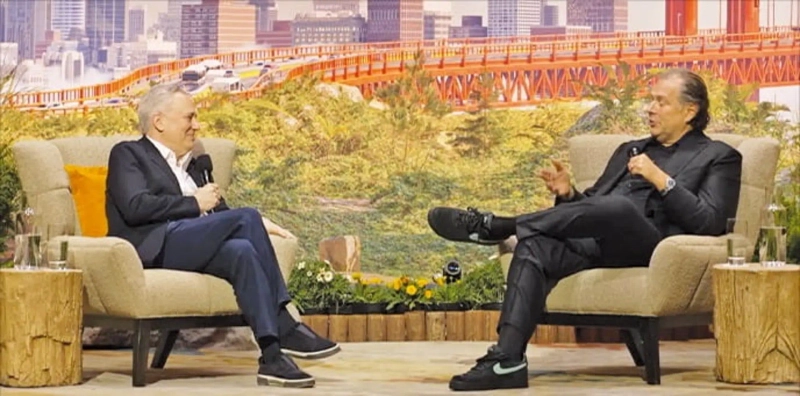
Mark Benioff, CEO of Salesforce, who is regarded as a leading pro-Democratic businessman in Silicon Valley, and David Sacks, the White House AI and virtual assets policy czar and a close associate of President Donald Trump, sat down together on the 14th (local time). Sacks predicted that "virtual assets will be fully integrated into the regulatory system within three years."
The event was arranged as part of Salesforce's annual event 'Dreamforce 2025.' In his keynote, CEO Benioff announced the launch of a new enterprise AI platform, 'AgentForce 360,' through a strategic partnership with OpenAI. The conversation with Sacks was disclosed only just before it began. Regarding cryptocurrency policy, Sacks said, "Under the Joe Biden administration, cryptocurrencies experienced four years of arbitrary prosecutions," adding, "because Senator Elizabeth Warren of the Democratic Party set the agenda." He then predicted, "With the Clarity Act moving through Congress, virtual assets will be fully integrated into the regulatory system within three years."
The Clarity Act is legislation intended to resolve the regulatory gap for virtual assets in the United States by clearly distinguishing the authorities of regulators such as the Securities and Exchange Commission (SEC) and the Commodity Futures Trading Commission (CFTC).
Sacks also gave his views on the direction of U.S. semiconductor export controls to China, which have become a key lever in the U.S.-China trade war. He explained, "The reason we should sell ordinary semiconductors to China, even if they are not the most advanced, is that we need to compete in the Chinese market to take market share from Huawei." He added, "If we're not careful, we could again create suppressed demand for Huawei."
This year's Salesforce Dreamforce, which is usually held in a festive atmosphere, felt noticeably different. In an interview with The New York Times (NYT) on the 10th, CEO Benioff showed a 'rightward' shift by saying, "I fully support the deployment of the National Guard in San Francisco." Benioff, who comes from a prominent San Francisco family, has been one of the most Democratic-leaning big tech leaders, having supported former President Barack Obama and former Democratic presidential candidate Hillary Clinton. Some protesters in front of the Dreamforce venue criticized Benioff's remarks. The most pressing topic at the press briefing during the event was also the comment on the National Guard deployment.
In the conversation with Sacks, seemingly conscious of this atmosphere, CEO Benioff opened with a joke, saying, "I was really looking forward to being able to invite someone who made a big turn to the right this year." Sacks, who is from Silicon Valley, was a co-founder of PayPal with Peter Thiel and Elon Musk, and later founded Palantir. After working as a venture investor, he was appointed last year as the U.S. government's AI and virtual assets czar. One of his nicknames is the 'Silicon Valley ambassador' for conveying the voices of the tech industry. In response to Benioff's joke, Sacks laughed and replied, "Didn't you turn to the left?" Sacks was involved with Thiel in the conservative-leaning college newspaper 'Stanford Review' while attending Stanford University.
San Francisco = Kim In-yeop, correspondent inside@hankyung.com

Korea Economic Daily
hankyung@bloomingbit.ioThe Korea Economic Daily Global is a digital media where latest news on Korean companies, industries, and financial markets.