

From informal remittances to gift tax evasion… virtual assets 'illegal transactions' abound
Summary
- Over the past five years, 72.7% of detected illegal foreign exchange transactions in Korea were conducted through virtual assets.
- Various methods such as trade payment remittance, disguised transfers as study-abroad funds, and evasion of inheritance and gift taxes are being carried out using virtual assets.
- Legislation to strengthen monitoring of virtual assets by the government has been delayed due to political circumstances, creating a regulatory gap.
Illegal foreign exchange transactions 73% use 'virtual assets'
Reached 9 trillion won over the past five years
Various methods including tax evasion
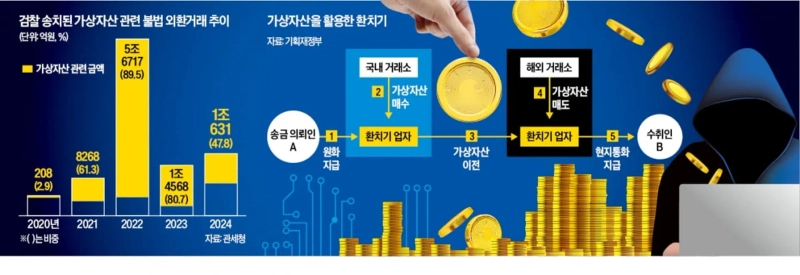
The Korea Customs Service found that about three-quarters of illegal foreign exchange transactions it detected and referred to prosecutors over the past five years were conducted using virtual assets such as Tether (USDT) and Bitcoin.
According to data received by Choi Gi-sang of the Democratic Party of Korea, a member of the National Assembly's Planning and Finance Committee, from the Korea Customs Service, illegal foreign exchange transactions detected and referred to prosecutors over the past five years (2020–2024) amounted to 12.4349 trillion won. Of this, transactions using virtual assets amounted to 9.0392 trillion won, accounting for 72.7% of the total.
Types of illegal foreign exchange transactions using virtual assets are becoming increasingly diverse. Some receive part of trade payments in virtual assets to evade customs duties and corporate taxes, or withdraw dollars abroad under the pretext of study-abroad expenses and then invest in virtual assets. Tax authorities also believe there may be cases of using stablecoins to move assets overseas to evade inheritance tax.
The government recognized this issue and initially planned to amend the Foreign Exchange Transactions Act in the first half of this year to monitor cross-border virtual asset flows in full. However, discussions were sidelined as impeachment and an early presidential election unfolded.
Coin-based export payment remittance… also abused to evade inheritance tax
Virtual assets 'illegal transactions' abound
Recently, the Korea Customs Service's Daegu Regional Customs Office arrested a Vietnamese group A that remitted export payments through virtual assets. Their method worked like this. When a Korean firm exported goods to Vietnam, the Vietnamese importer underreported the import payment and entrusted the difference to group A. The group bought virtual assets and sent them to Korean operatives, who sold them domestically, exchanged them into won, and deposited the proceeds into the Korean exporter's account. The amount this group remitted via this method from February 2022 over three years reached 843 billion won.
◇ If buried in Tether… hard to impose inheritance tax
On the 15th, the Ministry of Economy and Finance and the Korea Customs Service said that illegal foreign exchange transactions that remit trade payments using virtual assets, like group A, are spreading. Receiving export payments without going through banks avoids reporting to the Bank of Korea. A Korea Customs Service official said, "From the Vietnamese importer's standpoint, underreporting import amounts can save on customs duties," and "conversely, domestic exporters also have incentives to use similar methods to reduce corporate taxes."
Transferring funds abroad under the guise of study-abroad expenses to buy virtual assets is also a representative type of illegal foreign exchange transaction. Domestic banks refuse transfers for the purpose of virtual asset investment, so false documentation is used to disguise them as study-abroad funds. Cases have been detected where students sent money through domestic banks to their own foreign currency accounts under the pretext of study-abroad funds and then used those funds to buy virtual assets on overseas exchanges. If they later transfer these back to domestic exchanges and sell them, they can profit from the kimchi premium.
Experts point out that the actual scale of illegal foreign exchange transactions via virtual assets is likely far larger than detected. According to the Ministry of Economy and Finance, it is possible to check traces when virtual assets are purchased on domestic exchanges and then moved to personal wallets or overseas exchanges. The problem is that other areas remain opaque. Transfers between personal wallets or movements between personal wallets and overseas exchanges cannot be monitored.
Because of this structure, authorities cannot prevent the use of stablecoins like Tether (USDT) to evade inheritance and gift taxes. Authorities can see when a parent in Korea buys Tether on an exchange and stores it in a personal wallet. However, they cannot verify if it is later sent to a child's wallet abroad. Even if the child withdraws and uses the funds overseas, domestic institutions find it difficult to trace the source. If a parent dies while Tether remains in a personal wallet, a child abroad who knows the wallet ID and password can cash out and use the assets.
An industry official said, "Inherited assets can move slowly over a long period, so they may be more susceptible to abuse than trade payments."
◇ 'Monitoring law' also stalled amid martial law and impeachment
Under the current Foreign Exchange Transactions Act, individuals must state the purpose when sending more than US$100,000 abroad through a bank. Virtual assets are different. Because the Foreign Exchange Transactions Act does not define virtual assets, there are no specific regulations. If abnormal transactions such as continuous outflows from an account are detected, they are reviewed case by case under the Act on Reporting and Using Specified Financial Transaction Information (the Special Financial Transactions Reporting Act).
Choi Sang-mok, former Deputy Prime Minister and Minister of Economy and Finance, said in October last year that he would push to amend the Foreign Exchange Transactions Act in the first half of this year to add definition clauses for virtual assets and virtual asset service providers. If enacted, virtual asset exchanges would be required to pre-register cross-border virtual asset transactions and report the details (transaction date, transaction amount, etc.) to the Bank of Korea monthly. However, since the end of last year, with martial law, impeachment, and the presidential election, the revision has been delayed. Choi Gi-sang of the Democratic Party of Korea said, "The Foreign Exchange Transactions Act should be amended to add a definition of virtual assets and to regulate virtual asset transactions similarly to foreign exchange."
Gwang-sik Lee / Hae-ryeon Choi reporters bumeran@hankyung.com

Korea Economic Daily
hankyung@bloomingbit.ioThe Korea Economic Daily Global is a digital media where latest news on Korean companies, industries, and financial markets.