

Trump says he plans to "attend in person" tariff trial…could it be a first
Summary
- President Trump said he plans to directly attend the U.S. Supreme Court trial over the legality of tariff imposition.
- Bloomberg Economics reported that if the administration loses this trial, the U.S. effective tariff rate could fall to half or less, and there is a possibility of hundreds of billions of dollars in tariff refunds.
- The Trump administration said it can continue its tariff policy based on various trade law provisions.
Scheduled for November 5
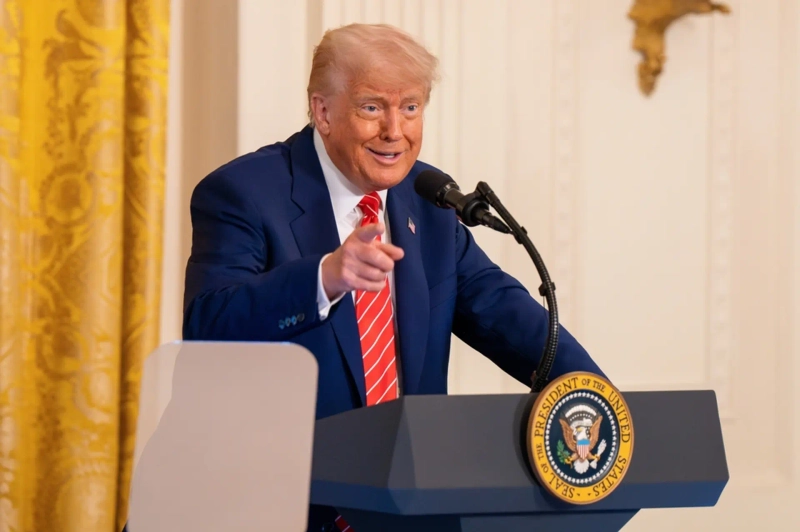
Trump: "If we lose, the finances will be a mess"
U.S. President Donald Trump said he intends to attend in person next month the U.S. Supreme Court hearing that will review the legality of his flagship policy of imposing tariffs. Major U.S. media reported that if this happens, it would be the first time a sitting U.S. president has attended a Supreme Court hearing.
President Trump told reporters in his White House office on the 15th (local time), "A big case is scheduled at the Supreme Court. I will say it is one of the most important cases in our nation's history," adding, "If we do not win that case, we will be weakened and in trouble for many years, and the finances will be a mess."
He added, "That's exactly why I want to go to the Supreme Court and watch."
The U.S. Supreme Court is scheduled to hold oral arguments on the 5th of next month in a case about tariffs imposed under the International Emergency Economic Powers Act (IEEPA). The Trump administration relied on the IEEPA to substantially increase tariffs on almost all trading partners. However, the U.S. Court of International Trade (CIT) ruled that the president had no basis under the IEEPA to take such measures and found them unlawful. The U.S. Court of Appeals for the Federal Circuit also in August upheld the lower court's conclusion by a 7-to-4 vote.
As the Trump administration appealed, the case reached the Supreme Court. Chris Kennedy, an economic analyst at Bloomberg Economics, predicted that if the Supreme Court upholds the lower court rulings and rejects the Trump administration's appeal, the U.S. effective tariff rate, which has risen to 16.3%, would be reduced to at most half and the United States might have to refund hundreds of billions of dollars in tariffs.
To date, sitting U.S. presidents have not attended oral arguments held at the Supreme Court.
However, even if not under the IEEPA, the president has various means to impose tariffs. In particular, tariffs related to automobiles and steel—which affect major Korean exports to the U.S.—are measures under Section 232 of the Trade Expansion Act and are separate from this lawsuit. In addition, Sections 301 and 122 of the Trade Act and Section 338 of the Tariff Act have also been cited as means to impose tariffs.
Park Su-rim, Hankyung.com reporter paksr365@hankyung.com

Korea Economic Daily
hankyung@bloomingbit.ioThe Korea Economic Daily Global is a digital media where latest news on Korean companies, industries, and financial markets.