

PiCK
Trump: "If China cracks down on fentanyl, we'll further reduce tariffs by 10 percentage points"
Summary
- President Trump said he could completely lift related tariffs if China actively cooperates in cracking down on fentanyl.
- China will suspend export controls on rare earths for one year and ease the export ban on vehicle semiconductors by Nexperia.
- China said it will stop tariff measures on U.S. soybeans and other agricultural products and begin large-scale purchases.
White House releases details of U.S.-China agreement
China will block fentanyl precursors to the U.S.
Ease export ban on Nexperia semiconductors
Stop controls on rare earths, begin soybean purchases
U.S. to lift retaliatory measures against Chinese firms
U.S. Treasury: "China's rare earths threat was a mistake"
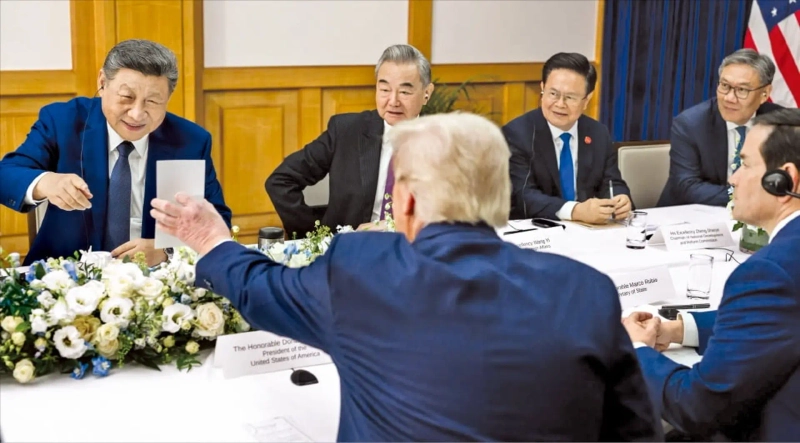
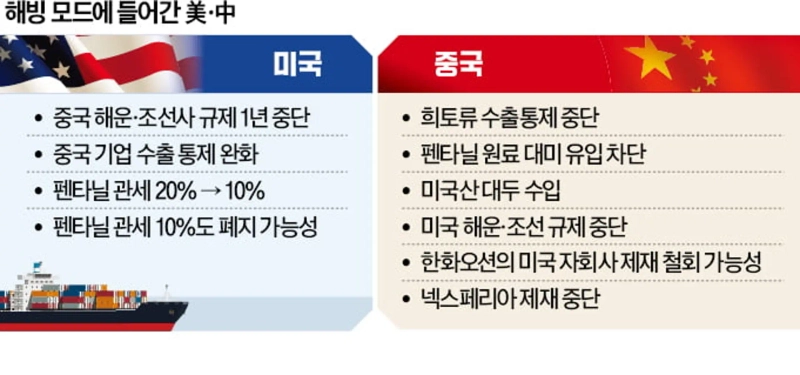
Trade tensions between the United States and China are entering a thaw. The two sides announced they would suspend sanctions imposed on each other's shipping and shipbuilding companies for one year. That's not all. U.S. President Donald Trump said he could completely abolish tariffs imposed on China related to fentanyl if China cracks down on the smuggling of the synthetic drug fentanyl and its precursors.
◇"We'll remove the remaining 10%"
President Trump said on the 31st of last month on his plane en route to Florida that he had discussed the fentanyl issue with Chinese President Xi Jinping and that "China is working very hard and I think they have the incentive to do so." He added, "As we see them (the Chinese government) doing that (cracking down on fentanyl), we will remove the remaining 10%." After taking office this year, President Trump imposed an additional 20% tariff on Chinese products because China was not cooperating in blocking fentanyl. Then, at the U.S.-China summit held in Gyeongbuk Gyeongju on the 30th of last month, after receiving China's promise of cooperation, the tariff rate on 'fentanyl tariffs', which had been 20%, was cut to 10%. If China actively cooperates in cracking down on fentanyl, he indicated that the remaining 10% tariff would also be removed. China agreed to block shipments of certain chemicals used to manufacture fentanyl to North America and to strictly control the global export of other specific chemicals.
◇China to suspend rare earths export controls for one year
On the 1st (local time), the White House released a fact sheet detailing the major points of the U.S.-China trade agreement on its website. According to the White House, China will suspend the implementation of the rare earths export controls and related measures announced on October 9. China plans to issue comprehensive licenses for the export of rare earths, gallium, germanium, antimony, and graphite for U.S. end users and their global suppliers. The White House explained that comprehensive licenses effectively mean a rollback of the export controls China implemented in April this year and in October 2022.
U.S. Treasury Secretary Scott Bessent told the Financial Times (FT) that he does not think China can carry out weaponizing rare earths because "we (the U.S.) currently have offsetting measures," and that China's leverage over the U.S. from rare earths would not last beyond 12–24 months. Secretary Bessent also warned, saying, "They warned everyone of the risk. They really made a mistake," and added, "Putting a gun on the table and firing a gun into the air are two different matters."
◇Semiconductor sanctions lifted
China agreed to ease the export ban on Nexperia's automotive semiconductors produced at its Chinese subsidiary. China's control of Nexperia's automotive semiconductor exports had heightened concerns of a supply chain crisis in the auto industry. In fact, Honda's plant in Mexico recently halted production due to a shortage of automotive semiconductors.
China also agreed to end anti-monopoly and anti-dumping investigations targeting U.S. companies that make up the semiconductor supply chain. It will extend procedures for tariff exemptions on certain U.S. products and maintain related tariff exemptions until December 31 next year.
China will also halt retaliatory tariff measures on agricultural products such as chicken and soybeans that embarrassed the Trump administration. This includes tariffs on U.S. chicken, wheat, corn, cotton, sorghum, soybeans, pork, beef, seafood, fruit, vegetables, dairy, and the designation of U.S. companies as export control targets.
China will purchase at least 12 million t of U.S. soybeans for the rest of this year and will buy at least 25 million t annually for the next three years. Soybeans are a weak spot for the Trump administration. Because Trump's support base is the U.S. Midwest agricultural region, which is a major production area, and China, the largest importer of U.S. soybeans, it is difficult to find alternative buyers if China stops trading.
China reduced the share of U.S. soybeans in its soybean imports from 20% in 2016 to 12% last year and had not purchased U.S. soybeans until recently this year.
New York=Park Shin-young, correspondent nyusos@hankyung.com

YM Lee
20min@bloomingbit.ioCrypto Chatterbox_ tlg@Bloomingbit_YMLEE