Summary
- President Trump nominated Kevin Warsh as the next Fed chair, saying “he will cut rates.”
- After Warsh’s nomination, markets reacted sharply to policy uncertainty, with gold, silver and Bitcoin plunging and the dollar strengthening.
- Analysts said Warsh could deliver at least two rate cuts, while his hawkish leanings could also pressure risk assets.
Forecast Trend Report by Period


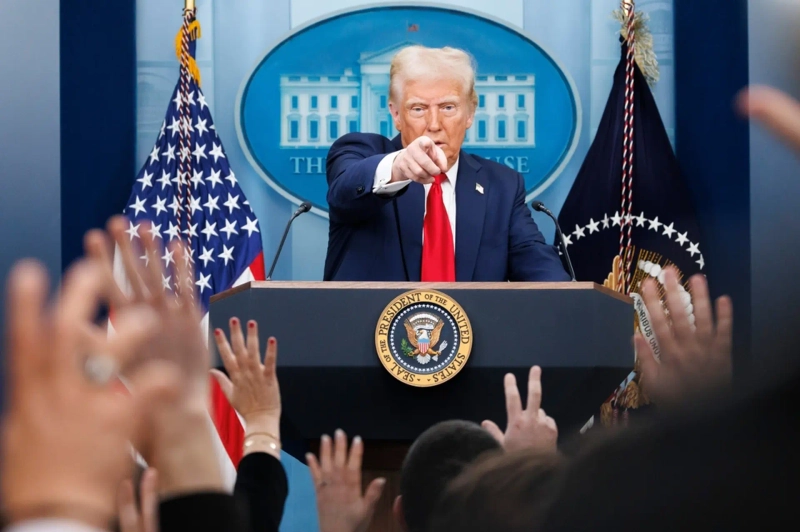
US President Donald Trump voiced confidence in Kevin Warsh, whom he has tapped to be the next chair of the US central bank, the Federal Reserve, calling him “a top-caliber person” and saying there would be “no problem” in the Senate confirmation process.
According to Reuters on the 31st (local time), Trump told reporters aboard Air Force One that Warsh is “so good” he could even win Democratic votes, adding that he is “high-caliber” and should face no major hurdles in confirmation, Reuters reported.
Trump nominated Warsh to succeed Chair Jerome Powell, whose term ends in May. Powell will step down as chair but will remain a Fed governor through 2028.
Even so, the confirmation outlook may not be smooth. Republican Sen. Thom Tillis said he would “block Warsh’s confirmation until the Justice Department’s ongoing investigation related to Chair Powell is concluded transparently.”
Tillis is a key figure on the Senate Banking Committee, which vets the Fed chair nomination. The committee currently consists of 13 Republicans and 11 Democrats, meaning that a single Republican defection could delay the process. Republicans also hold only a slim edge in the full Senate, making Tillis’s opposition a key variable.
Trump criticized Tillis as an “obstructionist,” saying that “if necessary, we could even wait to confirm Warsh until after he leaves the Senate.” Even so, he argued that “Warsh can be confirmed without Tillis’s support.” He did not specify which Democrats might vote in favor.
Earlier this month, the Justice Department began looking into cost overruns tied to the renovation of the Fed’s headquarters. Powell said he had done nothing wrong and countered that the probe was being used as a pretext to pressure monetary policy. Trump has repeatedly criticized Powell for being reluctant to cut rates, branding him “Too Late Powell,” and has demanded aggressive rate cuts to support the economy.
Asked what rate decision a Warsh-led Fed would make, Trump said, “He will cut rates,” adding, “You can tell from his TV interviews or what he says.” He added, “I want him to cut rates, but in the end it’s his decision.” When asked whether Warsh had promised rate cuts, Trump said, “He didn’t make any such promise.”
Financial markets swung sharply after the Warsh nomination. On the 30th, gold, silver and Bitcoin prices fell sharply. Markets worried about policy uncertainty, factoring in the possibility that Warsh could cut rates while simultaneously tightening liquidity.
Analysts are divided. CNBC cited an Evercore ISI note by Krishna Guha, who said Warsh is “more of a pragmatist than an ideological hawk,” and that he could potentially persuade the Federal Open Market Committee (FOMC) to deliver at least two rate cuts this year, possibly as many as three.
Renaissance Macro Research, however, said Warsh has displayed a hawkish tilt throughout his career, and that his recent dovish posture could be situational—warning that Trump may get an outcome different from what he expects.
The dollar, after seesawing following the nomination announcement, rebounded. Reuters, citing KCM chief market analyst Tim Waterer, reported that “a less dovish chair candidate, a stronger dollar and overbought conditions in precious metals combined to drive gold and silver lower.”
On Bitcoin’s plunge, Japan’s Nikkei said pressure mounted on growth-sensitive assets as expectations for monetary easing receded. The analysis noted that as liquidity shrinks and rates rise, investor appetite weakens for risk assets such as cryptocurrencies.
Matt Howells-Barby, vice president at crypto exchange Kraken, said “concerns about Big Tech’s massive AI investment are amplifying broader risk-asset jitters.”
Investor Cathie Wood posted on X the day before Warsh’s nomination that “the ratio of gold market cap to the US money supply has reached an all-time high,” arguing that “this is a signal commonly seen near the end of an upswing.” She said “the bubble is now in gold, not AI,” and predicted that a strong dollar could be a catalyst for a correction.
Kim Ye-rang, Hankyung.com reporter yesrang@hankyung.com

Korea Economic Daily
hankyung@bloomingbit.ioThe Korea Economic Daily Global is a digital media where latest news on Korean companies, industries, and financial markets.