

South Korea's potential growth rate to fall to 1.7% next year…slips to 24th out of 41 countries
Summary
- The OECD projected that South Korea's potential growth rate will fall to 1.7% next year, dropping to 24th out of 41 countries.
- South Korea's decline in potential growth rate is the second largest among the 14 countries with GDP over $1 trillion, increasing uncertainty in the investment environment.
- The OECD recommended raising growth potential through structural reforms and deregulation.
OECD, lowers estimates with each release
Lower than the U.S., whose economic size is 13 times larger
"Due to aging and delayed structural reforms"
Government struggles to achieve a 'rebound next year'
South Korea's potential growth rate for next year is projected to fall to 1.7%. The Organisation for Economic Co-operation and Development (OECD) expects South Korea's potential growth rate, which fell below 2% this year for the first time, to decline increasingly sharply. The government, which presented next year as the 'first year of a rebound in potential growth,' is likely to face deeper concerns.
According to the OECD's latest economic outlook report on the 3rd, South Korea's potential growth rate for next year was presented as 1.71%. It predicted that this year's potential growth rate of 1.92% will fall by 0.21 percentage points in one year. This is lower than the potential growth rate estimated by domestic institutions such as the Bank of Korea (about 1.8%).
The ranking of next year's potential growth rate is also expected to fall to 24th out of 41 countries. It fell behind Australia (2.09%) and Spain (1.94%), which have similar economic sizes, as well as the United States (2.03%), whose economy is nearly 13 times larger. The OECD said the ranking, which was 16th in 2023, would drop to 25th in 2027.
Potential growth rate refers to the maximum growth rate a country can achieve without causing inflation by mobilizing all production factors such as labor, capital, and resources. Analysts say this reflects a sharp decline in the working-age population due to low birthrates and aging, alongside delays in major structural reforms in areas such as labor and education.
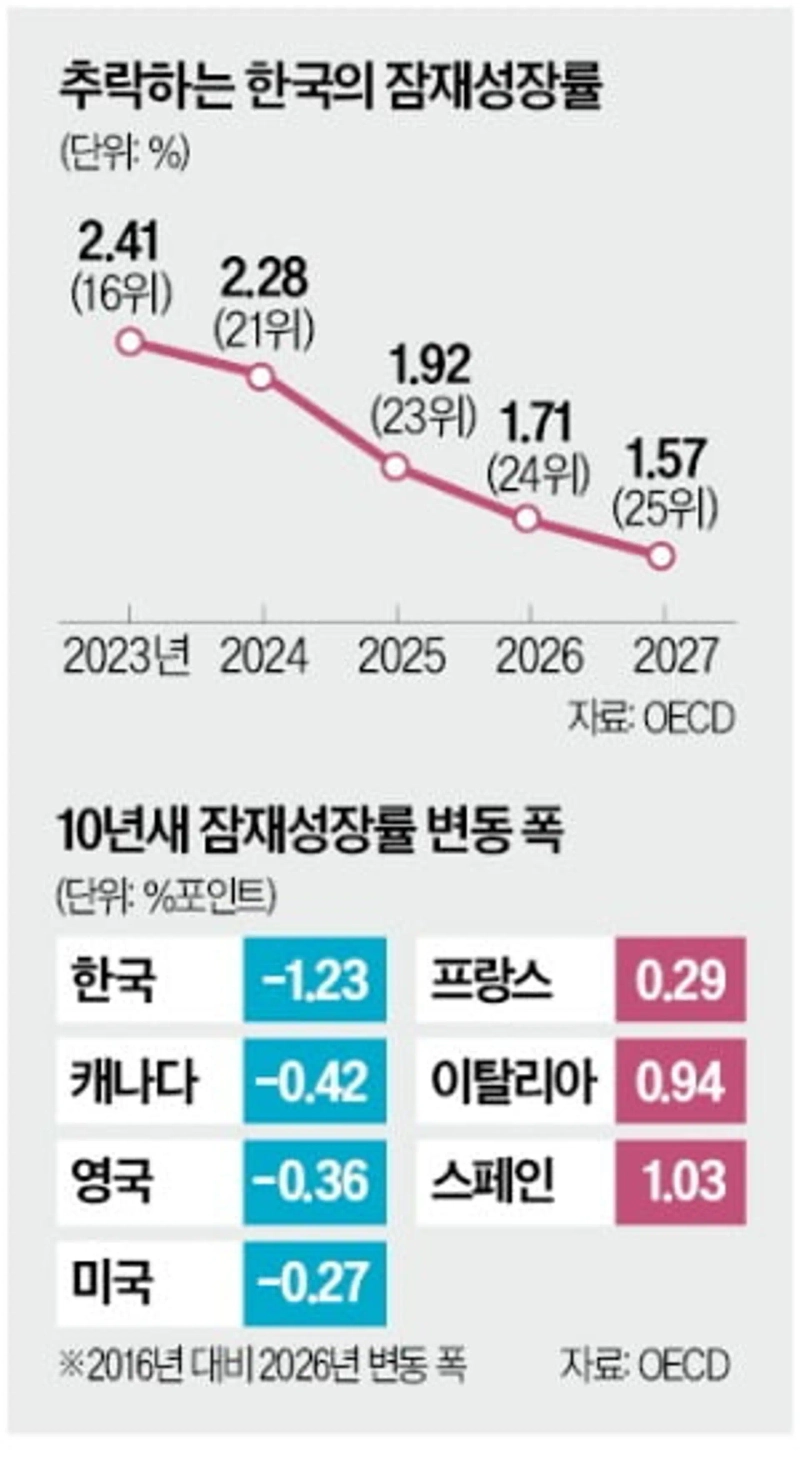
The OECD's estimates of South Korea's potential growth rate have been lowered each time a new economic outlook was released. At the end of last year, it presented 2.02% for this year and 1.98% for next year, expecting growth potential to remain around 2% for the time being. However, in June it presented 1.94% for this year and 1.88% for next year, signaling the collapse below the 2% range, and in this report it lowered them further by 0.2% percentage points and 0.17% percentage points, respectively. The potential growth rate for 2027, which the OECD began disclosing from this report, was 1.57%.
Although potential growth rates typically decline as economies grow larger, the problem is that South Korea's rate of decline is unusually fast. South Korea's potential growth rate is projected to fall from 2.94% in 2016 to 1.71% next year, a drop of 1.23% percentage points over 10 years. Among the 14 countries with GDP over $1 trillion, it had the second-largest decline after Türkiye, where political instability is severe.
Over the same period, Italy (0.94% percentage points) and France (0.29% percentage points) raised their potential growth rates, while the Netherlands (-0.07% percentage points), Australia (-0.23% percentage points), and the United States (-0.27% percentage points) saw declines in potential growth rates but were in better shape than South Korea.
In the report, the OECD recommended structural reforms such as reforming the dual structure of the labor market and shifting the wage system from seniority-based to performance-based pay. It also advised that regulatory reforms, such as lowering trade and foreign direct investment (FDI) barriers and opening sectors with significant state intervention to competition, could boost growth.
President Lee Jae-myung said at last month's senior secretaries and aides meeting, "We will make next year the first year of a rebound in potential growth," and announced plans to carry out structural reforms in six areas: regulation, finance, public sector, pensions, education, and labor. However, concrete policies have not yet been presented.
Reporter Kang Jin-kyu josep@hankyung.com

Korea Economic Daily
hankyung@bloomingbit.ioThe Korea Economic Daily Global is a digital media where latest news on Korean companies, industries, and financial markets.