

Japan, government bond yield tops 1.9% per year…Fear of yen carry trade liquidation grows
Summary
- It reported that the interest rate on Japan's 10-year government bond surpassed an annual 1.9% and reached its highest level in 18 years.
- It stated that concerns have been raised that global asset market volatility could increase due to the possibility of yen carry trade liquidation.
- It reported that markets are paying attention to the possibility that the Bank of Japan's policy rate increase could affect upward pressure on the yen and changes in investment strategies.
Sell-offs surge after rate-hike signals
10-year yield highest in 18 years
Market on alert: 'Will the yen appreciate?'
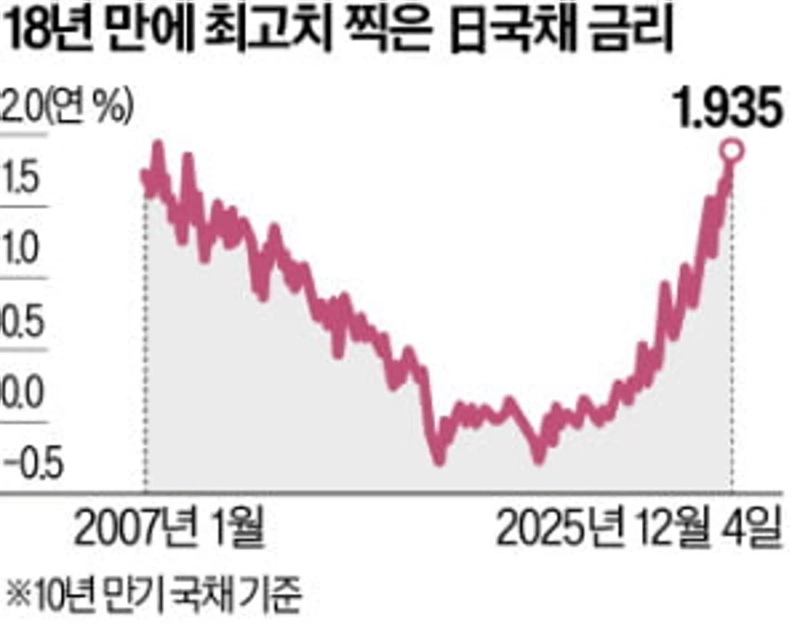
Japan's 10-year government bond yield exceeded an annual 1.9%, rising to its highest level in 18 years. The possibility of liquidation of "yen carry trades," which borrow yen in low-interest-rate periods to invest in high-yield assets, has been raised.
On the 4th in the Japanese bond market, the 10-year government bond yield, a long-term interest-rate indicator, briefly rose to 1.935% per year. It rose 0.045% point from the previous day, marking the highest level in 18 years since July 2007. The Nihon Keizai Shimbun reported, "As Kazuo Ueda, Governor of the Bank of Japan, showed a proactive stance toward an early policy rate increase, bond selling has continued." Bond selling has continued, causing government bond prices to fall (yields to rise).
Governor Ueda said at a financial and economic meeting on the 1st, "I want to appropriately assess the validity of raising the policy rate." The Bank of Japan will hold a monetary policy meeting on the 18th–19th. Markets increasingly perceived that the Bank of Japan is more likely to raise the policy rate this time. If the Bank of Japan raises the policy rate this month from an annual 0.5% to an annual 0.75%, a 0.25% point increase, it would surpass the '0.5% annual policy rate wall' for the first time in 30 years.
Concerns about fiscal deterioration due to the Sanae Takaichi administration's expansionary fiscal policy are also acting as a factor in the rise of Japanese government bond yields. Kazumasa Oguro, a professor in the Faculty of Economics at Hosei University, told the Nihon Keizai Shimbun, "Active fiscal policy will increase next year's budget and strengthen prospects for additional government bond issuance," adding, "This is a phase where monetary policy and fiscal policy together are driving rates up, and this rise is a structural movement."
Markets are on edge about the possibility of yen carry trade liquidation. The view is that a narrowing of the interest-rate gap between the U.S. and Japan could lead to upward pressure on the yen's value. When the Bank of Japan raised its policy rate in July last year and concerns about a U.S. economic slowdown coincided, large-scale yen carry trade liquidation occurred a month later, and this brought a 'Black Monday' shock to global markets.
Some interpret that the one-time sharp drop in Bitcoin's price to around $84,000 this month is not unrelated to concerns over yen carry trade liquidation. The Nihon Keizai Shimbun analyzed, "This is because a view has emerged that yen carry trade liquidation will occur in light of the Bank of Japan's policy rate increase."
There are also arguments that concerns about yen carry trade liquidation are premature. Just before last year's yen carry trade liquidation, the size of short positions betting on a decline in the yen's value was at an all-time high. In that situation, as rate-hike prospects grew, short positions were hurriedly unwound, causing yen carry trade liquidation, but the current situation is not the same.
Tokyo = Kim Il-gyu, correspondent black0419@hankyung.com

Korea Economic Daily
hankyung@bloomingbit.ioThe Korea Economic Daily Global is a digital media where latest news on Korean companies, industries, and financial markets.