

How high will the S&P be at the end of next year… Wall Street split '8000 vs 7100'
Summary
- On Wall Street, forecasts for the S&P500 index at the end of next year are widely divided.
- Morgan Stanley, Deutsche Bank and others predicted the S&P500 index would rise more than 10% further, but BoA said upside is limited.
- BoA identified current market liquidity limits and a slowdown in the Fed's rate-cutting as major risk factors.
Morgan Stanley "14% higher"
BoA "has reached liquidity limits"
Wall Street is seeing divergent forecasts for next year's U.S. stock market. Deutsche Bank, Morgan Stanley and others said the S&P500 index could rise more than 10% by the end of next year, but Bank of America (BoA) offered a conservative outlook.
On the 3rd (local time), according to Bloomberg, Bank of America said in a report that the S&P500 index is expected to finish around 7100 at the end of next year. It saw only 3.6% upside from that day's S&P500 closing price (6849.72). Savita Subramanian, BoA's U.S. equity and quant strategist, said, "U.S. companies will record double-digit earnings growth next year, but stock price gains will be minimal," adding, "current market liquidity has reached its limits, making a decline in stocks likely." She cited reductions in share buybacks, increased capital expenditures, and a slower pace of Federal Reserve (Fed) rate cuts as potential headwinds.
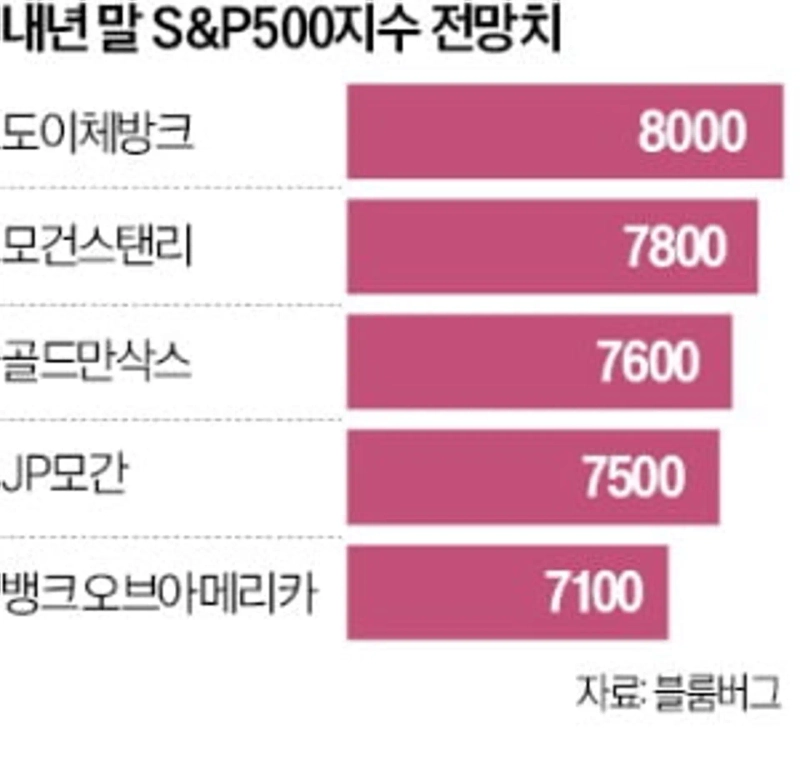
By contrast, Deutsche Bank forecast the S&P500 could rise to 8000 next year. Morgan Stanley also projected it could rise 13.8% from current levels to reach 7800. Goldman Sachs (7600) and J.P. Morgan (7500) also predicted more than 10% further upside. Deutsche Bank focused on corporate earnings, expecting explosive earnings growth next year and that the rally would spread beyond the tech stocks that have led the market. J.P. Morgan, which had maintained a cautious view, has also recently shifted toward a bullish stance.
Over the past month, the S&P500 has experienced volatile trading amid concerns about an artificial intelligence (AI) bubble and the Fed's rate decisions. BoA cautioned about an AI bubble but noted it differs from the irrational dot-com bubble of the 2000s, as corporate earnings support valuations (price relative to earnings).
On the same day, Jean Boivin, head of BlackRock Investment Institute, said at a media briefing, "We do not view framing this as a bubble as particularly useful to investors at this stage," and argued that "seeing the AI boom simply as a bubble is an incomplete interpretation."
Han Kyungje reporter hankyung@hankyung.com

Korea Economic Daily
hankyung@bloomingbit.ioThe Korea Economic Daily Global is a digital media where latest news on Korean companies, industries, and financial markets.