

"Forces Opposed to American Values"…Trump's 'Change of Heart' After Criticizing China [Sang-eun Lee's Washington Now]
Summary
- "Reported that the National Security Strategy (NSS) depicted China dualistically as both a competitor and an economic partner."
- "Said that, unlike the aggressive China policy of the Trump administration's earlier term, the will to engage in a showdown with China has weakened."
- "Reported that the U.S. has revised its strategy for maintaining the world economic order, making cooperation with allies such as the U.S.–South Korea alliance more important."
Dual attitude toward China in the NSS
The will to 'settle the matter' has disappeared, but concerns about maintaining leadership remain
The status of the ROK–U.S. alliance will depend on whether solutions are proposed
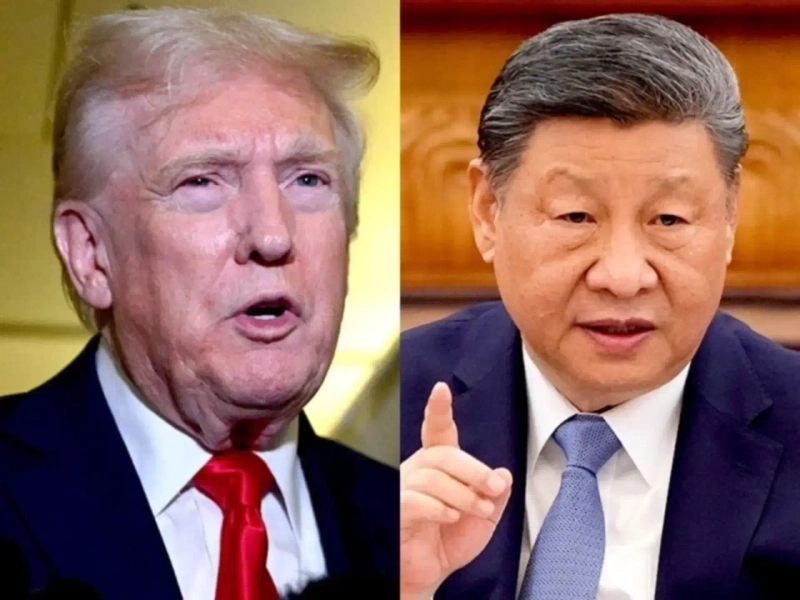
The shockwave from the National Security Strategy (NSS) that U.S. President Donald Trump quietly released on the night of the 4th is large. Not because it contains new content, but because it was written with a startling frankness for an official U.S. government document.
The United States pours out various expressions in this document that it is 'overextended.' "The era in which the United States supported the world order like Atlas is over," it says. Criticism of previous administrations sometimes seems excessive, but the passage pointing out that "focusing on everything means focusing on nothing" regarding the fact that previous NSS documents covered almost every issue makes one nod in agreement.
The key keyword running through the entire document is China. However, the descriptions of China are clearly deliberately dual. In sections that perceive China as a competitor or adversary, it refers to China with variations such as 'non-Western competitor,' 'other country,' and 'potential hostile power.'
On the other hand, in passages that convey a message of trying to get along economically, it called China 'China.' A representative phrase is "creating a truly mutually beneficial economic relationship with Beijing." The sentence that maintaining good relations with China could "grow the current $30 trillion U.S. economy to $40 trillion" almost looks like an unrequited crush. This contrasts with the 2017 NSS of Trump's first administration, which aggressively defined China as "a force seeking to build a world order antithetical to American values and interests."
President Trump in his first term thought he would settle matters with China in a showdown. It was the time to do so, and it was arguably late. Even if it ran counter to free trade, there needed to be some way to control China, whether through tariffs on Chinese goods or in some other form. Still, the blow to China was minimal.
Returning after four years, President Trump faced a much stronger China. He no longer has the will to 'have a showdown' with China. In fact, when the International Emergency Economic Powers Act (IEEPA), which has weak legal grounds, was used as a means to impose tariffs, this outcome may already have been foreseen. Ultimately, the story is that he planned to pat China on the back and end with 'let's try to get along.'
Kim Heung-jong, former president of the Korea Institute for International Economic Policy (KIEP), participated in a forum in Washington, D.C. last week and said, "(In the upstream parts of the supply chain) there is no way to restrain China's overwhelming dominance," adding, "If China imposes export controls, it's over." "No matter how strong a champion is, if oxygen is not supplied, he dies," he said. Today's China has no intention of trading with other countries if it does not have to. It is pushing a strategy to verticalize everything, internalize, and impoverish neighboring countries. The traditional economic theory that free trade can lead to shared prosperity has lost its way in the face of this strategy.
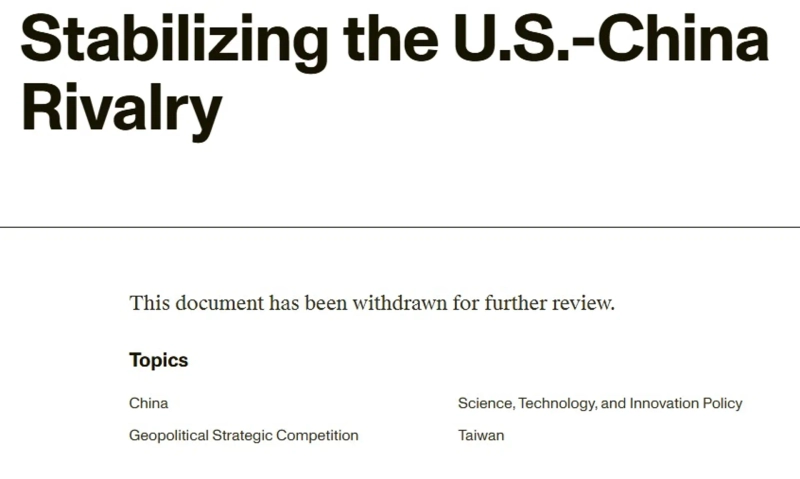
Recently, the RAND Corporation in Washington released a report arguing that the United States should recognize China and send positive signals to Beijing by using deterrence toward Taiwan. When controversy grew, the report was temporarily taken down, but skepticism is growing in Washington that the time to engage in a decisive battle with China has already passed. It just appears messy and confused because voices of China hawks within the Trump administration are mixed in.
Of course, there is not the slightest thought of relinquishing the United States' position as the world's number one. To prevent that from happening, this year's NSS's message is to share burdens with allies and concentrate on the Indo‑Pacific and the Western Hemisphere. But underlying that is the concern, "we don't really know how to handle a China that has now grown too large." How much South Korea understands this concern of the United States and provides solutions will determine future relations with the United States.
Washington = Sang-eun Lee, correspondent selee@hankyung.com

Korea Economic Daily
hankyung@bloomingbit.ioThe Korea Economic Daily Global is a digital media where latest news on Korean companies, industries, and financial markets.