

"'Santa rally coming' vs 'Rebound from January next year'"…Securities firms split over December outlook
Summary
- Over the past 10 years, the December KOSPI's probability of rising remains at 50%, and some securities firms cited U.S. liquidity provision and net buying by foreign investors as the basis for the possibility of a Santa rally.
- Other securities firms, however, forecast that a full market rebound will occur from January next year after 4Q results are confirmed, and advised defensive portfolio strategies for December.
- They said investors should consider low-volatility ETFs, high-dividend stocks, and attention to semiconductor and shipbuilding sectors that look promising next year.
50% probability of index rise in December over the past 10 years
If U.S. rate cuts and won weakness ease
Switch to net buying by foreign investors
Attention to small- and mid-cap stocks, holding companies, and other high-dividend stocks
Likely to rise after 4Q results are confirmed
Defensive diversification with low-volatility ETFs, etc.
Interest in semiconductors, shipbuilding, etc., in preparation for next year's rise
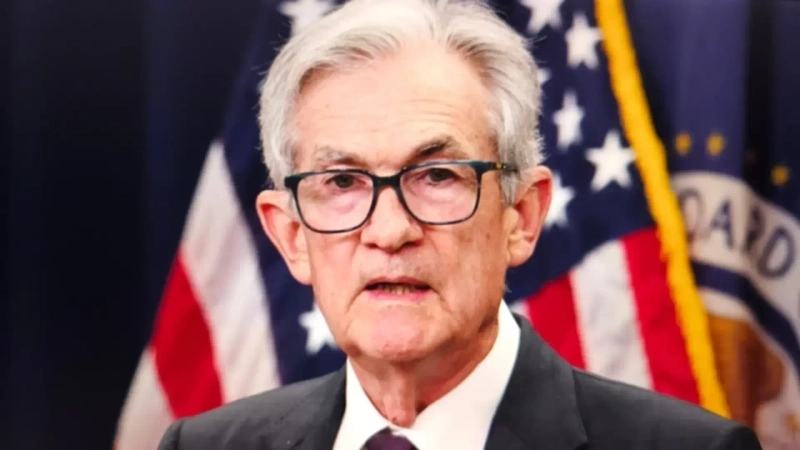
Will a 'Santa rally' come at the end of this year? Securities firms are divided over the direction of the market in December. Some expect that after mid-December, U.S. liquidity provision will intensify and foreign investment funds will 'comeback' to the domestic market, while others predict that a full rebound will begin from January next year after 4Q results of listed companies are confirmed.
◇"If U.S. liquidity is supplied, a rebound will begin"
According to the Korea Exchange on the 9th, the probability that the KOSPI index rose in December over the past 10 years (2015–2024) was calculated at 50% on a monthly basis. Five out of ten years closed higher, and the other five closed lower. This means that the Santa rally investors expect each year actually occurs only half the time.
Experts' views on the year-end market direction are also mixed. Those expecting a Santa rally cite a fall in the won/dollar exchange rate and an expansion of foreign net buying. Recently, the won/dollar exchange rate has been trading around 1,470 won per dollar.
The market sees a high possibility that the U.S. central bank (Fed), which ended quantitative tightening (QT), will cut the policy rate at the Federal Open Market Committee (FOMC) meeting scheduled for the 9th–10th. The view that U.S. liquidity could be supplied again has gained traction as Kevin Hassett, a leading 'dove' and chair of the White House National Economic Council (NEC), has been mentioned as a candidate for the next Fed chair.
Lee Jae-man, a researcher at Hana Securities, said, "With the end of the U.S. federal government shutdown, government spending will also increase," adding, "If U.S. liquidity increases and the won's weakness calms, foreign funds could return to net buying and the index could rebound."
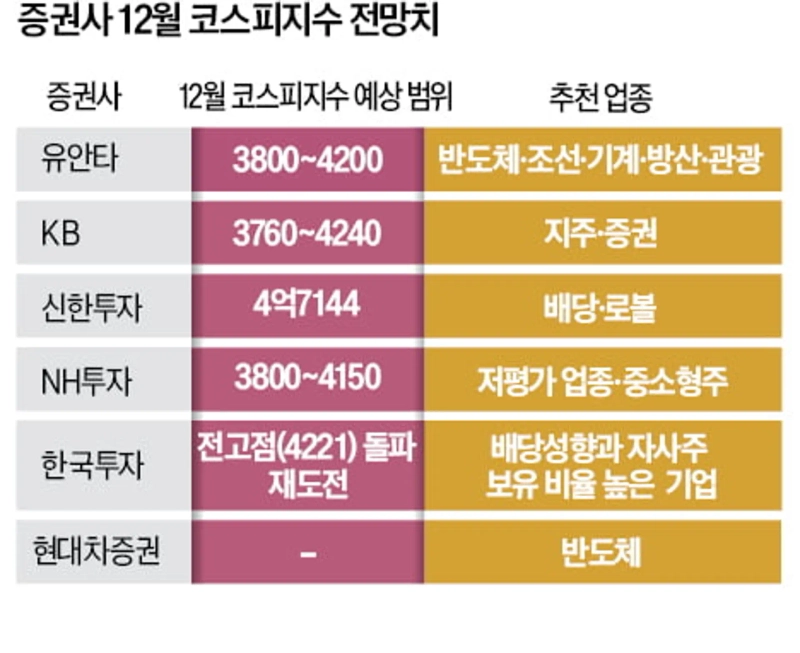
KB Securities proposed a projected KOSPI range of 3760~4240 for December and recommended increasing equity allocation. Researcher Lee Eun-taek said, "Investment funds that had concentrated on large-cap stocks are spreading to low-valuation stocks and small- and mid-cap stocks," and predicted, "holding companies, securities firms, and other high-dividend stocks could rebound."
Yuanta Securities also presented a KOSPI forecast band of 3800~4200. Researcher Kim Yong-gu said, "The KOSPI's 12-month forward price-to-earnings ratio (PER) has fallen to around the historical average of 10.5x, increasing price attractiveness," and expected, "With the resumption of U.S. liquidity provision and other factors, a Santa rally could unfold in the domestic market in December."
◇"The full rebound will be from next year"
On the other hand, some view that a KOSPI rebound will be difficult in December this year. Although the earnings per share (EPS) of companies listed on the Kospi market rose sharply by 34.2% year-to-date, the KOSPI's price-to-earnings ratio (PER) has instead been trending lower.
Noh Dong-gil, a researcher at Shinhan Investment Corp., said, "This is a phenomenon that appears when there is insufficient confidence that earnings will further improve or when the rate environment is unstable," and analyzed, "It is highly likely that the market will try to rebound from January next year after confirming whether 4Q earnings are solid." Shinhan Investment presented a December KOSPI forecast range of 3800~4150.
According to Shinhan Investment, similar phenomena occurred in April–May of 2016, 2021, and 2024, when EPS rose but PER fell due to monetary policy uncertainty. Researcher Noh said, "At that time as well, the index entered a full uptrend only after corporate earnings announcements," and advised, "Until a strong market appears in January, it is necessary to defend portfolios with dividend stocks or rovol (low-volatility) exchange-traded funds (ETFs)." He added, "Prepare for a market rebound next year by paying attention to sectors like semiconductors, shipbuilding, and trading companies, where profit estimates are being revised upward."
Korea Investment & Securities also forecast that December's market will find it difficult to be bullish. Researcher Kim Dae-joon explained, "Trading value is decreasing, and December is seasonally not active for trading." He warned, "If major supply-demand players such as foreigners and institutions customarily reduce trading ahead of year-end settlements and domestic and external negative factors overlap while trading decreases, market volatility could expand."
Reporter Shim Seong-mi smshim@hankyung.com

Korea Economic Daily
hankyung@bloomingbit.ioThe Korea Economic Daily Global is a digital media where latest news on Korean companies, industries, and financial markets.