

Already secured 23 trillion won?…Chinese firms, demand for 'export-approved' NVIDIA AI chips explodes
Summary
- The approval of NVIDIA's H200 AI chip exports to China is expected to concentrate demand within China next year.
- Chinese big tech companies have reportedly already reduced their dependence on NVIDIA through in-house chip development and diversification of AI infrastructure.
- It was mentioned that domestic chips could quickly catch up to the H200, suggesting that in the long term supply chain stability and independent domestic production could become substitutes.
Approval of NVIDIA H200 exports to China
H200 demand in China expected to concentrate next year
Chinese companies diversify 'AI infrastructure'
Dependence on foreign products lowered, so demand may be limited
Concerns expressed over U.S. 'technology gap' strategy
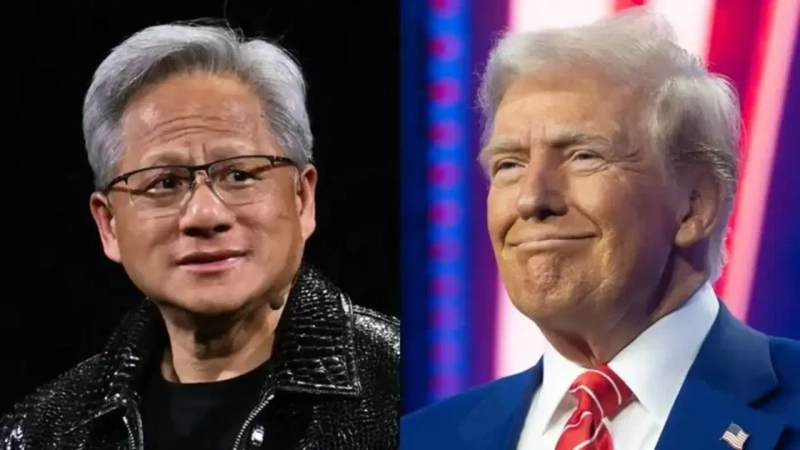
U.S. President Donald Trump allowed NVIDIA's artificial intelligence (AI) accelerator 'H200' to be exported to China, leading to forecasts that demand will concentrate next year. Observers say orders are expected to flood in as Chinese companies are likely to expand GPU investments they had postponed for more than two quarters.
However, some analyses suggest that even if H200 orders increase in the short term, demand could be limited because Chinese big tech firms have already lowered their dependence on NVIDIA through their own chips. Within China, there are also remarks that "the H200 should be seen as a temporary measure until AI chips are domestically produced."
On the 9th (local time), Chinese tech outlet 36Kr reported that local conglomerates placed orders for a total of $16 billion (about 23 trillion won) worth of AI chips 'H20' earlier this year, but actual deliveries did not occur. At the time, it was expected that those orders would convert to H200 demand next year as NVIDIA's export route to China opened. The H200's performance is six times higher than the H20.
Major Chinese companies are said to have postponed GPU investments for more than two quarters out of concern for regulations. Therefore, if the actual export route for the H200 opens, orders are expected to pile up next year. Guoxing Securities predicted, "The allowance of H200 exports will raise capital expenditures across China's data centers, AIDC, servers, and cloud one step further."
There are views that the H200 will increase demand within China even more than NVIDIA's latest chip 'Blackwell.' The H200 is the highest-performing chip among those applying the Hopper architecture, the generation before Blackwell.
A domestic industry researcher told 36Kr, "Major Chinese Internet and cloud companies have been developing most of their models tailored to Hopper-based GPUs, and switching to a new architecture now would require rewriting compute modules, toolchains, and core software, which would demand enormous manpower and time." From the perspective of Chinese companies, demand for the H200 is expected to be higher than for the latest Blackwell.
While demand for the H200 may concentrate immediately within China, the analysis that dependence on NVIDIA will continue to decline in the long term is gaining traction. Chinese big tech firms are reducing dependency on NVIDIA by developing their own chips or diversifying AI infrastructure.
Chinese economic media First Financial cited cases like Tencent, Baidu, and 360, reporting that "Chinese big tech firms have already switched substantially to domestic chips." Tencent said during its earnings announcement that "GPUs are currently sufficient," and Baidu stated that "most of the internal inference work is based on its own chip, the 'Kunlun P800.'"
The outlet predicted that even if NVIDIA re-enters the Chinese market with the H200, the domestic ecosystem that has grown so far will likely be 'replaceable' in the future. A local industry source also told 36Kr, "The H200 is a practical chip that Chinese customers can apply immediately, but domestic chips are already deeply embedded in various inference scenarios."
Within China, there is a strong sense of caution regarding the H200 export approval as a "political calculation by the U.S. to maintain a technology gap."
Chinese economic media Caixin quoted an industry source as saying, "The H200 is six times ahead of the China-destined H20 in performance, but compared to NVIDIA's top lineup it is a compromise about 18 months behind." Multiple Chinese outlets noted that while H200 exports were allowed, exports of Blackwell and Rubin remain blocked. This has been interpreted as a strategy to release the H200 that local companies need to increase dependence on NVIDIA chips and to check domestic development in China.
Guoxing Securities emphasized, "Given the pace of progress by China's leading firms, domestic chips can quickly catch up with the H200," and added, "Independent domestic production remains the mid- to long-term substitute, if only for supply chain stability."
Kim Daeyoung, Hankyung.com reporter kdy@hankyung.com

Korea Economic Daily
hankyung@bloomingbit.ioThe Korea Economic Daily Global is a digital media where latest news on Korean companies, industries, and financial markets.