

PiCK
[Q&A] Powell: "Hold until economic progress... no possibility of a rate increase" [Fed Watch]
Summary
- Jerome Powell, Chair of the Federal Reserve, said he will stick to holding rates steady until clear economic progress signals emerge.
- He said that next year's GDP growth forecast was significantly revised upward, citing consumption and AI-related investment.
- He said the FOMC's decision to cut rates was a close call internally, and that the possibility of a rate increase is almost nonexistent.
Said at a press conference immediately after the December FOMC
GDP growth forecast increase is "thanks to consumption and AI investment"
"Close call" internal disagreement in decision to cut rates
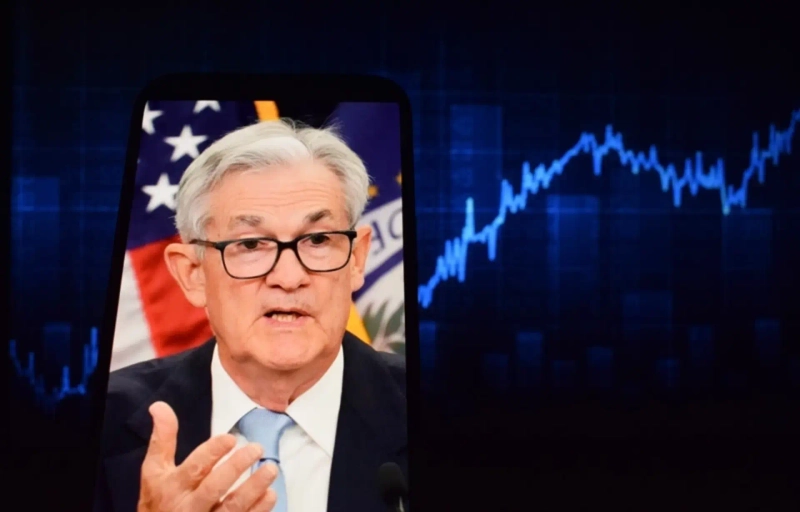
Jerome Powell, chair of the U.S. central bank (Fed), said at a press conference on the 10th (local time) immediately after the December Federal Open Market Committee (FOMC) that the Fed will hold rates steady on further rate-cut possibilities until clearer signals of economic progress emerge. He added bluntly that "there are very few people (inside the Fed) who see it that way" regarding the possibility of a rate increase.
Regarding the large upward revision to next year's U.S. gross domestic product (GDP) growth forecast in the Summary of Economic Projections (SEP) released that day, he cited robust consumption and large-scale investments in data centers and AI.
Meanwhile, the FOMC used the phrase "close call" in describing the decision to cut rates, suggesting significant internal disagreement. The following is a Q&A.
▶ The statement newly included the phrase "consider extending the timing of additional adjustments." Does that mean the Fed will remain on hold until clearer signals of economic progress emerge in inflation, employment, and other outlooks?
"Yes. With the adjustments made since September, the policy stance can now be seen as within a broad range that corresponds to neutral across various estimates. As stated in today's statement, we are in a good position to judge the degree and timing of any further adjustments based on incoming indicators, changes in forecasts, and the balance of risks. The new phrase emphasizes that we will carefully evaluate those incoming data."
▶ The outlook for next year appears quite optimistic. Is this a proactive bet on AI?
"A variety of factors are reflected in the outlook. Broadly speaking, we see upward trends in growth not only within the Fed but also in external forecasts. Partly, consumption has remained resilient, and another part is spending on data centers and AI — that is, AI-related investment is supporting business fixed investment. The baseline outlook can be viewed as 'solid growth next year.'"
▶ You previously described rate cuts from a "risk management" perspective. Is the rate-cutting in the risk management phase over now?
"Looking back, we maintained a policy rate of 5.4% for over a year while inflation remained very, very high. During that time, the unemployment rate and labor market were quite resilient. But over the summer of 2024, inflation came down and the labor market began to show signs of weakening. So, under our framework, when the risks to our two goals (employment and inflation) become more similar, we thought it appropriate to move from a policy tilted heavily to one (at the time inflation) to a more balanced, nearer-neutral setting, and we did make that adjustment. I think the current policy position is a 'good place' to watch how the economy unfolds."
▶ The SEP shows growth forecasts rose significantly, but unemployment did not fall much. Is that reflecting an AI factor?
"What that implies is clearly higher productivity. Some of that could be due to AI, and on the other hand, productivity has been structurally higher in recent years. Assuming about 2% annual productivity growth, you can sustain higher growth without greatly increasing employment."
▶ Today's decision appears to have been quite divided within the committee. In addition to the two who officially opposed the rate cut, four took positions that could be interpreted as a 'soft dissent' (reserved opposition).
"The situation now is that our two goals are in tension with each other. The interesting point is that everyone around the FOMC table agrees that inflation is still too high and needs to come down, and also agrees that the labor market has weakened and there are additional downside risks. I acknowledge it is not the usual situation where everyone fully agrees on the direction and action. The spectrum of views is more widely spread. I think that reflects the particular nature of the current situation."
▶ Could there come a time when such dissent actually harms the Fed's communication or messages about the future policy path?
"I don't think we are at that point now. It's a close call, meaning that convincing arguments can be made on either side."
▶ Like in the 1990s, is there a possibility that after three rate cuts the Fed could raise rates again?
"At this point, I think there are very few people who see the next move being a rate increase."
▶ What is the basis for confidence that the unemployment rate will not continue to rise in 2026?
"Current rates are within the neutral range. Policy is still not excessively accommodative, and inflation excluding tariffs has made progress. Going forward, incoming data will determine the next action."
▶ Many people noted you said at the October meeting "in foggy conditions you slow down," and the market interpreted that to mean you would not cut in December but would cut in January.
"At the time I said 'there is no guarantee we will move in December,' and that was correct. The reasons for the rate cut today are, first, that the labor market is gradually cooling. On inflation, recent figures have come in a bit lower. Service prices are coming down, but that effect has been offset by rising prices of goods subject to tariffs."
New York = Park Shin-young, correspondent nyusos@hankyung.com

Korea Economic Daily
hankyung@bloomingbit.ioThe Korea Economic Daily Global is a digital media where latest news on Korean companies, industries, and financial markets.