

Fed Divided Over Rate Cuts…Signals Only One Cut Next Year [Fed Watch]
Summary
- The Fed presented a forecast of a single rate cut next year, but internal disagreement surfaced as seven members advocated keeping rates unchanged.
- The split in the dot plot suggests lower predictability in monetary policy decisions, which could create confusion in the markets.
- The Fed raised its U.S. economic growth forecast for next year to 2.3% and projected that inflation will gradually ease.
One rate cut expected next year
Seven call to keep rates unchanged…internal disagreement exposed
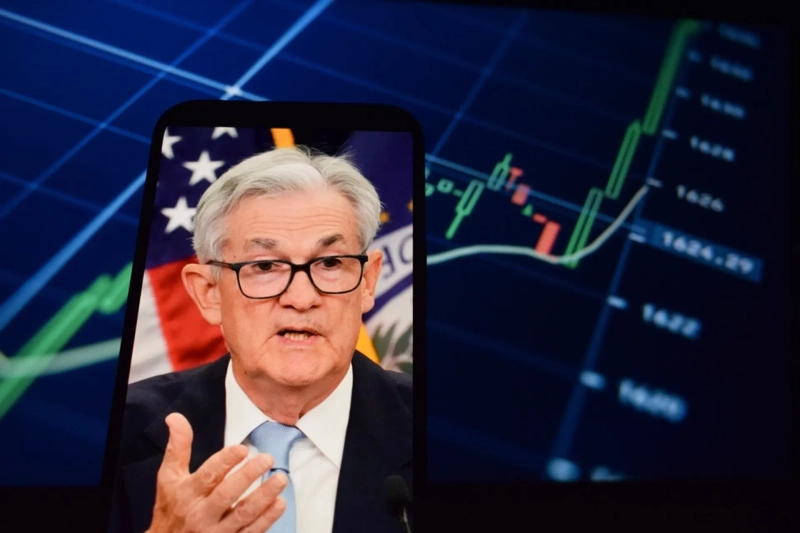
"I acknowledge that this is not the usual situation where everyone fully agrees on the direction and actions of (monetary policy)."
This was Jerome Powell, chair of the U.S. central bank (Fed), responding on the 10th (local time) at a press conference immediately after the December Federal Open Market Committee (FOMC) meeting to a question about whether there were internal disagreements. In the dot plot released that day, the median 2026 rate forecast remained 3.4%, unchanged from before, but a closer look shows that cohesion among the members has weakened compared with the past. Of the 19 people who provided dot plot projections, 7 said no cut would be necessary next year. As divisions within the Fed surfaced, significant difficulties in monetary policy decision-making are expected.
Seven say "no cut needed"
In the Summary of Economic Projections (SEP) released the same day, the Fed presented the median year-end policy rate forecast for next year at 3.4%. This is the same as the September forecast. Taking that into account, a single 0.25 percentage point cut is expected next year.
However, the anonymous dot plot entries suggest that future monetary policy decisions may not be easy. Of the 19 members, 7 said no cuts are necessary next year. Four thought one cut would be appropriate, and eight thought at least two cuts were needed. It is difficult to set a single direction for monetary policy. Divergent views among Fed members can send confusing signals to the market, which is something Wall Street investors would prefer to avoid.
In particular, in this rate-cut vote, Steven Myron, a Fed board member and a close associate of U.S. President Donald Trump, argued for a larger 0.5 percentage point cut, while Jeff Schmid, president of the Federal Reserve Bank of Kansas City, and Austan Goolsbee, president of the Federal Reserve Bank of Chicago, maintained that rates should be kept unchanged. According to the Wall Street Journal (WSJ), this is the first time in six years that three members dissented at the FOMC.
The statement issued immediately after the FOMC meeting included the phrase, "In considering the magnitude and timing of any further adjustments, the Committee will carefully assess incoming data, revisions to the economic outlook, and risks to the balance of risks." That wording was used at a meeting a year ago, and thereafter the Fed did not resume cutting rates until September of this year.
Raising growth forecast, lowering inflation
The Fed described inflation as "still somewhat elevated." It also said that "uncertainty about the economic outlook remains elevated," and projected next year's gross domestic product (GDP) growth at 2.3%. This is 0.5 percentage point higher than the 1.8% projection in September and 0.6 percentage point higher than this year's expected growth of 1.7%.
Chair Powell said the upward revision to the growth forecast reflected productivity improvements, some of which may be due to artificial intelligence (AI). He said, "Partly it is that consumption has remained resilient, and partly it is spending on data centers and AI-related expenditures — investments related to AI have been supporting business fixed investment," adding that "the baseline outlook can be seen as 'robust growth next year.'"
The unemployment rate for next year was projected at 4.4%, unchanged from September. The personal consumption expenditures (PCE) inflation rate is expected to fall from 2.9% this year to 2.4% next year.
After the FOMC's rate-cut announcement, President Trump criticized at a White House event, calling it a "stubborn central bank" and saying "Chair Powell is a rigid person." He also said, "(Today the Fed should have) cut rates at least twice as much."
Investors are watching whom President Donald Trump will name as the next chair to succeed Chair Powell, whose term ends in May next year.
Kevin Hassett, chair of the White House National Economic Council (NEC), has been cited as a leading candidate, and a final sole nominee could be announced as early as this month. In a Fox News interview ahead of the FOMC decision, Hassett said there is "certainly the possibility of a 0.50 percentage point cut or more," echoing President Trump's view.
New York=Park Shin-young, correspondent nyusos@hankyung.com

Korea Economic Daily
hankyung@bloomingbit.ioThe Korea Economic Daily Global is a digital media where latest news on Korean companies, industries, and financial markets.