

Lee Chang-yong on IMF podcast: "We need to weigh the pros and cons of deposit tokens and stablecoins" [Kang Jin-kyu's BOK Watch]
Summary
- Bank of Korea Governor Lee Chang-yong said on an IMF podcast that it is necessary to jointly examine the pros and cons of deposit tokens and stablecoins.
- The Bank of Korea said it plans to expand pilot projects by pursuing experiments on digital currency based on deposit tokens alongside issues related to stablecoins.
- The governor stated that distinguishing structural factors from cyclical factors is important for monetary policy and pointed out the risks of low growth and zero interest rates.
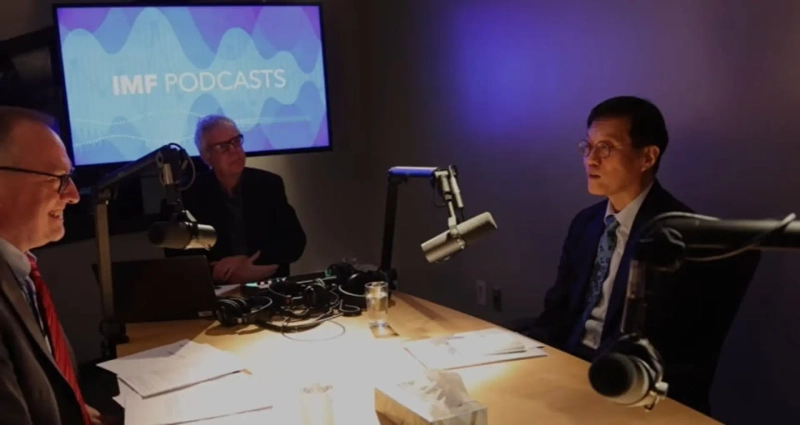
Bank of Korea Governor Lee Chang-yong appeared on an International Monetary Fund (IMF) podcast and said, "It is necessary to examine the pros and cons of deposit tokens and stablecoins together." He suggested comparing deposit-based tokens led by the Bank of Korea with stablecoins expected to be issued by the private sector.
The IMF released a podcast containing this content on the 11th (local time). The governor visited Washington, D.C. in October to attend the IMF meeting and had a 20-minute conversation with Jeff Cons, an IMF blog editor, on various topics including price stability, structural reform, and digital currency.
Asked about tasks during the roughly six months remaining in his term, the governor brought up digital currency. He said, "We are conducting experiments with deposit tokens to prepare for digital currency." The Bank of Korea is conducting the Hangang Project, an experiment in tokenized digital currency based on deposits. After completing the first project this year, it is preparing a second experiment to distribute government subsidies via digital currency.
While discussing deposit tokens, the governor also raised the issue of stablecoins. He said, "The stablecoin issue is emerging as a fairly important matter domestically," and added, "I hope the pilot project for deposit tokens will be expanded so that the pros and cons of issuing deposit tokens and stablecoins can be examined together."
The IMF also showed strong interest in the structural reform report, one of the key projects the governor has promoted since taking office. When the editor asked, "You are covering topics such as aging, immigration, and artificial intelligence. Does this mean the central bank's role should change to address structural factors beyond traditional monetary policy?" the governor replied, "Structural reform does not contradict the central bank's mission of 'price stability.'"
He said, "To conduct proper monetary policy, you need to understand what the main drivers of changes in the economic environment are," adding, "You need to distinguish whether growth slowdown is a cyclical factor or a structural factor." He emphasized, "Korea's recent growth slowdown involves structural factors such as aging and changes in global supply chains that are as important as cyclical factors."
Mentioning the risk that "Korea could fall into low growth and zero interest rates," he said, "Advanced economies responded after the financial crisis with quantitative easing and expansionary fiscal policy, but Korea cannot do that because it does not have an international currency." He emphasized that reforms to address structural causes are needed, such as mitigating low birth rates, increasing women's labor market participation, and extending the retirement age, to avoid falling into such a situation.
He also noted the difficulty of structural reform. The governor said, "Structural problems are difficult and complex to solve," adding, "There are groups that benefit and groups that lose, so acceptance of policy proposals differs." He said, "High-quality research is necessary, but more important is that the research be in a form that the public can easily read," stressing that communication is important.
On how important central bank independence is, he said, "Independence is key for price stability, but cooperation with the government is essential for other functions." He believes the central bank cannot handle financial stability, the role of lender of last resort, and the resolution of failing financial institutions on its own.
Regarding the Bank of Korea's Korean-style dot plot, he introduced it by saying, "We are publishing a three-month outlook, and internally experimenting with six-month and one-year outlooks." However, the decision on adoption is expected to be made only after the first half of next year. He said, "The final decision will be made by my successor." His term runs until April next year.
Reporter Kang Jin-kyu josep@hankyung.com

Korea Economic Daily
hankyung@bloomingbit.ioThe Korea Economic Daily Global is a digital media where latest news on Korean companies, industries, and financial markets.