

Summary
- U.S. rate cuts notwithstanding, Bitcoin prices remain weak.
- Major institutions such as Standard Chartered have significantly lowered Bitcoin price forecasts from previous levels.
- The market is divided over next year's Bitcoin price direction depending on liquidity recovery and the four-year cycle theory.
Outlook for Bitcoin next year
Liquidity shortage due to the shutdown
Down more than 20% compared with two months ago
Weakness continues despite positive factors
Experts' price forecasts
Cut from $300,000 to $150,000
Mixed outlook for next year
"Weakness following the four-year cycle"
"New highs if liquidity recovers"
With the year-end approaching, Bitcoin prices have been unable to escape weakness. Many market participants had expected Bitcoin prices to rebound if the U.S. central bank (Fed) cut its benchmark rate, but Bitcoin has remained range-bound even after this month's rate cut. Major institutions are revising their rosy forecasts downward. The market is sharply divided between bullish and bearish views on Bitcoin's direction next year.
Bitcoin remains weak
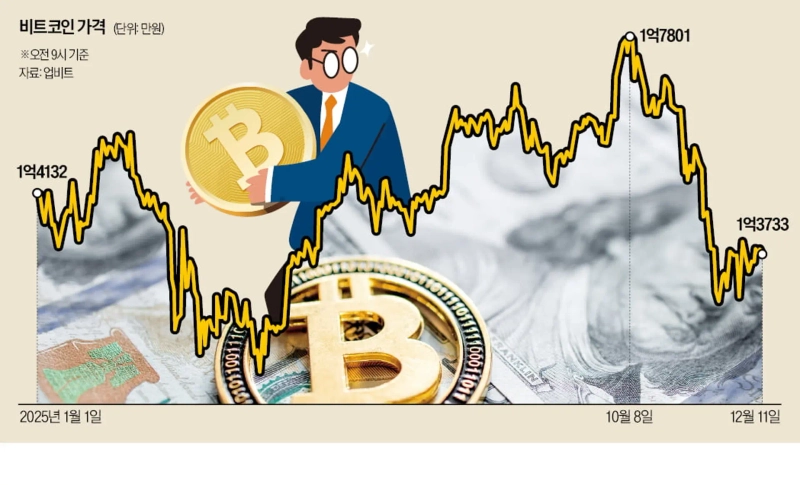
On the 14th, according to domestic cryptocurrency exchange Upbit, Bitcoin was trading at KRW 137,170,000 at 4:00 p.m. on the 12th. Compared with the record high on October 8 (KRW 178,010,000) recorded at 9:00 a.m., it has fallen more than 20%. Recently, Bitcoin has been trading at prices lower than those on January 1 of this year (KRW 141,320,000).
One reason cited for Bitcoin's sharp fall in the fourth quarter is market concerns over a lack of liquidity. The U.S. federal government was 'shut down' for a record 43 days from October 1 due to a budget dispute between President Donald Trump and the Democratic Party, preventing liquidity from being supplied. Coupled with worries about the Fed's hawkish monetary policy, Bitcoin fell as low as KRW 125,600,000 on the 22nd of last month.
The market expected that a Fed rate cut would relieve liquidity tightness and allow Bitcoin to rebound. However, Bitcoin did not rebound even after the Fed's Federal Open Market Committee (FOMC) met and lowered the benchmark rate by 0.2% points to an annual 3.50~3.75% on the 10th (KRW 136,700,000).
One reason Bitcoin's weakness has persisted despite the U.S. rate cut is that the Fed carried out a "hawkish (preference for monetary tightening) cut." In its FOMC statement, the Fed said it would "consider the range and timing of any further policy rate adjustments," signaling an intention to hold rates steady in January. The Fed officials' dot plot also showed a median policy rate of 3.4% next year, suggesting the possibility of only one rate cut in the U.S. next year.
Will Bitcoin rebound again?
Financial firms are revising their previously optimistic forecasts one after another. Standard Chartered (SC) Group said in a report released on the 9th that it lowered its Bitcoin year-end forecast from $200,000 to $100,000 and revised next year's target from $300,000 to $150,000. Cathie Wood, CEO of ARK Invest, also lowered her 2030 Bitcoin forecast from $1.5 million last month to $1.2 million.
Market participants' views on Bitcoin prices after next year are split. Some expect weakness to continue following the "four-year cycle" theory that Bitcoin plunges every four years around the halving, while others expect a rebound driven by liquidity. Kim Min-seung, head of the Korbit Research Center, said, "In the past, if the 'seasonality' centered on the halving determined the cycle rhythm of Bitcoin prices, this time the liquidity cycle is acting as the main variable," adding, "If tightening ends and a rally in asset markets resumes after the first half of next year, there is a possibility that Bitcoin prices will seek a new high above the levels of last November."
Reporter Jeong Ui-jin justjin@hankyung.com

Korea Economic Daily
hankyung@bloomingbit.ioThe Korea Economic Daily Global is a digital media where latest news on Korean companies, industries, and financial markets.