

'NVIDIA chip exports to China' — U.S. Congress opposes Trump
Summary
- The U.S. Congress is strongly opposing the decision to allow NVIDIA's H200 chip exports to China, saying it could harm national security and strategic interests.
- Bipartisan lawmakers have moved to tighten regulations, including introducing a bill to ban exports of H200 and 'Blackwell' chips to China for 30 months.
- NVIDIA plans to increase production of H200 chips after export approval, but uncertainty remains over sales growth due to delayed Chinese government approval and China's push for semiconductor self-reliance.
Controversy over AI chip exports to China
House China committee chair sends letter to Commerce Secretary
'Ban on advanced AI exports' bill also introduced
NVIDIA to ramp up H200 chip production
U.S. AI czar: "China is rejecting U.S. chips"
Donald Trump’s administration’s decision to allow exports of NVIDIA’s high-performance artificial intelligence (AI) chip 'H200' to China has sparked backlash in the U.S. Congress. The mood is one of opposition even within the ruling Republican Party as well as among Democrats, with critics calling it a "decision that harms America's strategic interests." The H200 is a generation older than NVIDIA’s latest AI chip 'Blackwell' but is about six times more powerful than the H20 chips currently exported to China.
Bill introduced to ban H200 exports
According to foreign media on the 14th, Rep. John Moolenaar (Republican), chairman of the House Select Committee on U.S.-China Competition, questioned the rationale for the administration's decision to allow H200 exports to China. In a recent letter to Commerce Secretary Howard Lutnick, Moolenaar said, "Approving the sale of cutting-edge chips to Chinese companies risks weakening the special strategic advantage President Trump achieved during his first term," and argued that "allowing China to purchase millions of chips that outperform domestic chips would undermine President Trump's efforts to maintain U.S. dominance in the AI industry."
President Trump announced on social media on the 8th that "the United States will allow the supply of H200 products to China under conditions that ensure we can strongly maintain national security." He also defended exports to China, saying, "We will protect national security, create American jobs, and remain a leader in AI." However, Moolenaar pointed out that the Huawei-developed AI semiconductor 910C chip was manufactured not on the Chinese mainland but at Taiwan's TSMC, and that this fact, which raised the performance of Chinese AI chips, was overlooked. Under the Commerce Department's decision, Huawei will no longer be able to produce the next-generation 910D chip at TSMC. As a result, the 910D chip is expected to perform worse than the previous 910C chip.
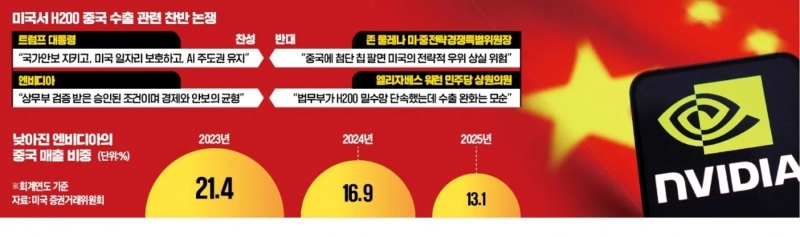
NVIDIA has argued that allowing H200 exports to China is necessary to acclimate China to U.S. AI chips. The company warned that banning NVIDIA's H200 exports could prompt companies like Huawei to develop independent chips that would replace NVIDIA. After President Trump approved the exports, NVIDIA said that "providing H200 to approved customers who have passed the U.S. Commerce Department's review is a very beneficial balance for the United States." Moolenaar's camp, meanwhile, argues that if H200 exports are allowed while production through TSMC is blocked, it could restrain the development of Chinese AI chips.
In Congress, voices of concern over allowing H200 exports to China have come from both Democrats and Republicans. Six lawmakers, including Republican Sen. Peter Ricketts (vice chairman of the Senate Foreign Relations Committee's East Asia and Pacific Subcommittee) and Democratic Sen. Chris Coons, recently introduced a bill to ban the export of H200 and Blackwell chips to China for 30 months. Sen. Elizabeth Warren, the Democratic ranking member of the Senate Banking Committee, called it "contradictory" that the Justice Department announced a crackdown on an H200 smuggling network worth $50 million just hours before Trump's H200 announcement, and asked Secretary Lutnick to respond by the 19th on 'the scale of H200 exports' and 'the potential for military misuse of H200,' among other issues.
U.S. AI czar: "China seeks semiconductor self-reliance"
NVIDIA's revenue share from China fell to 13.1% this year amid semiconductor export restrictions after the start of Trump's second term. Accordingly, NVIDIA is reported to plan increasing production of H200s approved for export to China.
However, uncertainty remains as the Chinese government has not approved H200 purchases. Chinese authorities held an emergency meeting on the 10th to discuss whether to allow H200 imports but did not reach a decision. David Sacks, the White House's so-called AI czar and member of the President's Council of Advisors on Science and Technology, told Bloomberg Tech in an interview that "China is rejecting our chips," and added, "That is because they want semiconductor self-reliance."
Donghyun Kim 3code@hankyung.com

Korea Economic Daily
hankyung@bloomingbit.ioThe Korea Economic Daily Global is a digital media where latest news on Korean companies, industries, and financial markets.