

Exchange rates and bonds, This month's average exchange rate 1470 won… Highest since the foreign exchange crisis
Summary
- This month the won·dollar average exchange rate exceeded 1470 won, recording the highest level since the 1997 foreign exchange crisis.
- Experts said there is a high possibility that the high exchange rate trend will continue next year due to increased overseas investment.
- They said that as a result of the sharp rise in the exchange rate, the 3-year government bond yield is expected to continue at a high level within the 3~3.15% box range.
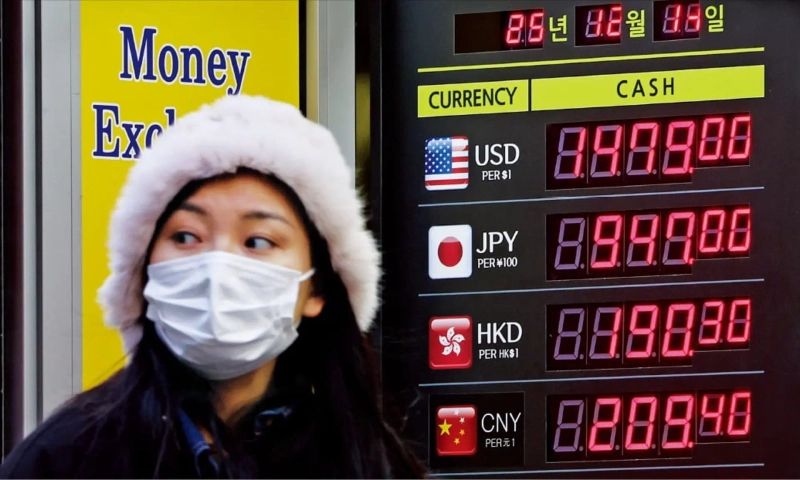
This month the won·dollar average exchange rate remained above 1470 won, sustaining the highest level since the 1997 foreign exchange crisis. As a structural flow continues in which dollar buying volume overwhelms selling volume due to increased overseas investment, the prevailing view is that the high exchange rate trend will continue next year.
According to foreign exchange authorities on the 14th, the won·dollar exchange rate traded in the low 1470 won range during the 9–11th, then rose intraday to 1479 won 90 jeon in overnight trading on the 12th before closing at 1477 won. The won·dollar exchange rate exceeded 1450 won on an intraday basis for more than a month since the 7th of last month (1456 won 90 jeon). According to the Bank of Korea, the average exchange rate for the first two weeks of this month (based on weekly trading closing prices) was 1470 won 40 jeon. Last month's average exchange rate was 1460 won 44 jeon, the highest in 27 years since March 1998 (1488 won 87 jeon). If the current trend continues, December is also expected to maintain the highest level since the foreign exchange crisis.
Experts say that as investments overseas by the National Pension Service and individual investors continue to increase, the won is likely to remain weak for the time being. Oh Jae-young, a KB Securities researcher, said, "This year individual investors net purchased $30.9 billion (about 45.65 trillion won) worth of U.S. stocks," adding, "there is a high possibility that the net buying trend will continue next year, prolonging the (won·dollar) supply-demand imbalance."
The surge in the exchange rate is also affecting the bond market. Until mid-October, the 3-year government bond yield, which had been moving around an annual 2.5%, surpassed the 3% level in early this month and closed at an annual 3.093% on the 12th. Kim Chan-hee, a Shinhan Investment Corp. researcher, explained, "The 3-year government bond yield is expected to remain at a high level within the annual 3~3.15% box range."
Nam Jeong-min, reporter peux@hankyung.com

Korea Economic Daily
hankyung@bloomingbit.ioThe Korea Economic Daily Global is a digital media where latest news on Korean companies, industries, and financial markets.