

"S&P500 settles at the 7000 level…Should hold profitable AI stocks"
Summary
- Goldman Sachs and Bank of America presented optimism that the S&P 500 will settle at the 7000 level in 2026 based on AI infrastructure investment and U.S. corporate operating profit margins reaching record highs.
- Wall Street says it is paying attention to the growth potential of energy infrastructure and utility stocks and healthcare and biotech innovation companies due to the surge in power demand from AI data centers.
- Firms like BlackRock say that in an environment of slowing liquidity, quality stocks with low debt and strong cash flows will receive greater attention.
U.S. stock market outlook
AI bubble theory vs trend theory put to the test
Corporate operating profit margins reach record highs, etc.
'Rally' likely to continue this year as well
Surge in power demand from data centers
Energy infrastructure and utility stocks promising
The hot obesity drug craze continues
Innovative companies in healthcare and biotech
High chance of becoming a 'second NVIDIA'

This year, the U.S. stock market is expected to become a harsh testing ground for the big tech firms that drove the tech-stock frenzy over the past two years. These companies must generate tangible profits in the artificial intelligence (AI) sector to dispel concerns about a stock-price bubble. On Wall Street, there is an expectation that, with a slower pace of rate cuts in the U.S. this year compared to last year, investor attention will focus on companies with low debt and strong cash flows.
The first year of AI monetization
Goldman Sachs recently expressed optimism in a report that the S&P 500 index will settle at the 7000 level in 2026. The basis is that the 'harvest period' will arrive, where AI infrastructure investment outputs will begin to convert meaningfully into companies' earnings per share (EPS).
Savita Subramanian, Bank of America (BoA) chief strategist, cited 'maximizing efficiency' as the keyword that will run through the market in 2026. BoA said in a recent report, "U.S. corporate operating profit margins will reach historical highs in 2026," presenting an optimistic outlook. It dismissed concerns comparing the current market situation to the late-1990s dot-com bubble. Back then, stock prices rose on expectations without revenue models, but now companies are said to be innovating cost structures with AI. In particular, it expects intelligent automation across manufacturing, logistics, and services to become full-fledged, entering a stage where profits relative to revenue structurally expand.
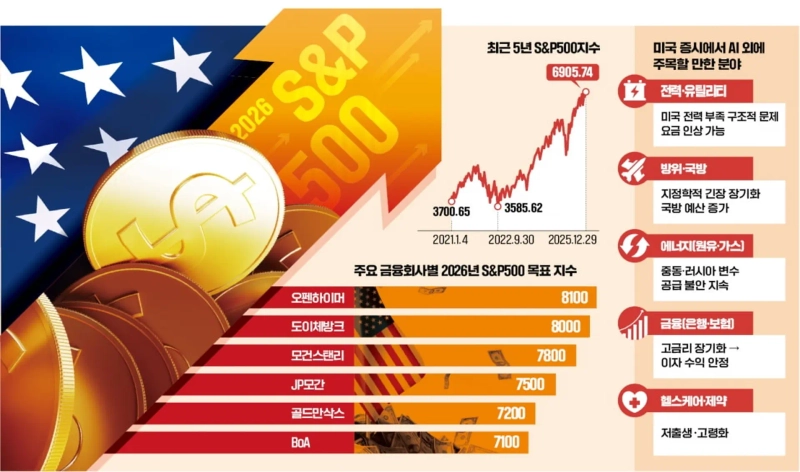
Meanwhile, Morgan Stanley maintains a cautious view. While AI technology will contribute to corporate cost reductions, the speed at which it leads to actual revenue growth may be slower than market expectations. It expects 2026 to mark the end of the era driven by a few big tech firms—the 'Magnificent 7 (the seven advanced tech stocks listed on the New York Stock Exchange)'—and to become a 'selective market' where only companies that successfully embed AI into actual business models will survive.
Focus on energy and utilities
Besides AI, Wall Street is focusing on energy infrastructure and utilities. Goldman Sachs analyzed in a recent report that "the surge in power demand to operate AI data centers will provide a powerful momentum to the utility sector for the first time in over a decade." It added that nuclear power generation and stocks related to power grid modernization, which can provide stable power supply, are likely to emerge as new leaders in the 2026 market.
Expectations for healthcare and biotech are also high. BlackRock assessed that "beyond the GLP-1 obesity drug craze, innovative companies in gene editing and precision medicine have a high chance of becoming a 'second NVIDIA' in 2026."
Liquidity reallocation under neutral rates
Another key variable for the U.S. market in 2026 is the behavior of the U.S. central bank (Fed). Many expect the U.S. benchmark interest rate to remain at a neutral rate of 3.0~3.5% this year. That is not far from the current (3.5~3.75% annually). Larry Fink, chairman of BlackRock, said, "2026 will be a year when the value of companies with low debt and strong cash flows is rediscovered." As liquidity growth slows, marginal companies with weaker financing capabilities will be phased out, and market funds are expected to concentrate more on high-quality stocks with strong results, deepening polarization in the market.
New York=Shin-young Park, correspondent nyusos@hankyung.com

Korea Economic Daily
hankyung@bloomingbit.ioThe Korea Economic Daily Global is a digital media where latest news on Korean companies, industries, and financial markets.