PiCK
Cutting off Russia’s cash flow and containing China… Trump’s ‘Oil Road’ shakes the global order
Summary
- The Trump administration said it reached a deal under which India pledged to halt purchases of Russian crude in exchange for a cut in tariffs on Indian imports from 50% to 18%.
- It reported that the US is strengthening its energy hegemony by securing control over Venezuelan oil and pursuing an energy supply-chain reshuffle targeting India, Latin America, Iran and Cuba.
- It said Lee Seong-gyu, a research fellow, interpreted that expanding exports of US and Venezuelan crude and stepping up investment in Venezuelan oil production would generate substantial gains for US companies.
Forecast Trend Report by Period


Trump’s oil war
(1) Oil as leverage… a more muscular US energy hegemony
Trump’s ‘oil war’… squarely targeting China and Russia
India tariff cut 50→18% in return for halting purchases of Russian crude
Cutting off funding to hit Russia’s economy while also laying groundwork to check China
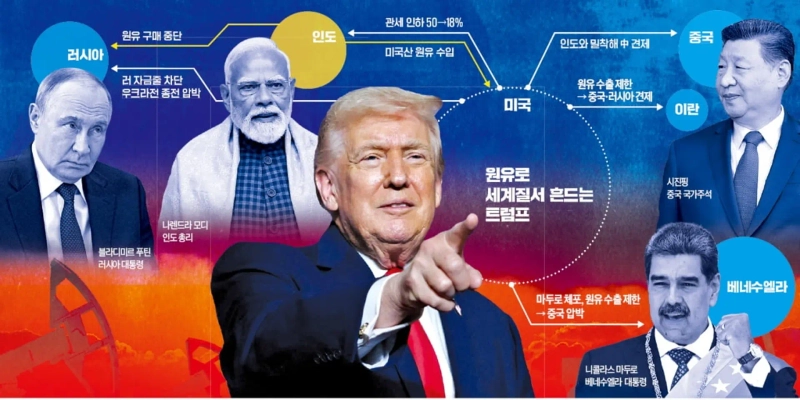
The Donald Trump administration is pressing ahead with an uncompromising drive to strengthen its dominance in the oil market. After securing control over Venezuela’s oil—home to the world’s largest reserves—earlier this year, it said on the 2nd (local time) that it had won a commitment from India to stop buying Russian crude. With energy demand surging on the back of artificial intelligence (AI) and other factors, Washington is accelerating its push in the fight for energy primacy.
President Trump wrote on social media that “(Indian Prime Minister Narendra Modi) agreed with the United States to stop buying Russian crude oil, and potentially buy much more (crude) from Venezuela,” adding that “this will help end the war in Ukraine that is taking thousands of lives every week.” In return, the US agreed to cut tariffs on Indian imports to 18% from 50%. The US had been imposing an additional 25% tariff on India—on top of a 25% reciprocal tariff—as a sanction over imports of Russian crude.
Russia is the world’s third-largest oil producer after the US and Saudi Arabia, but has struggled to secure buyers under Western economic sanctions since the outbreak of the Ukraine war. With India, which absorbs 35–40% of Russian crude, stepping away, Russia’s economy is set to take a significant hit.
This could serve as a stepping stone for the US to cement its grip over energy markets. Elected on the slogan “Drill, baby, drill” (drill more), President Trump signed a series of executive orders after taking office in January last year to boost US fossil-fuel production. Last month, after arresting Venezuelan President Nicolás Maduro, he announced that US companies would take part in rebuilding Venezuela’s oil production facilities and would hold control over the oil produced.
Trump also said that “Mexico will stop supplying oil to Cuba.” By wielding control over energy as a weapon, he has bolstered US influence across the Western Hemisphere. He is also tightening restrictions on Iran, including limits on crude exports, while issuing threats of attack.
Ultimately, this is aimed at China. China is a major importer of Russian, Iranian and Venezuelan crude targeted by Western sanctions. It has been buying discounted energy that is difficult to sell at full price under sanctions and using it to lower production costs. By reshaping energy markets, the US is seeking to squeeze out rivals and entrench its political and economic leadership globally.
US hits four birds with one stone, delivering a ‘fatal blow’ by severing crude links
Donald Trump’s move on the 2nd (local time) to secure India’s pledge to halt purchases of Russian crude is not a simple trade deal. It has the effect of rewiring the global order through oil. It can cut off Russia’s funding while also containing China by drawing India closer. In addition, the US can expect an economic upside from expanding exports of US crude to India.
◇ Pressuring Russia and China at the same time
If India, in line with the agreement with President Trump, stops or sharply reduces imports of Russian crude, Russia will lose a critical source of funding for the war in Ukraine. Since the Joe Biden administration, the US has pressured Russia through measures such as supplying weapons to Ukraine and blocking Russian financial institutions from the SWIFT financial messaging system.
But the reason the war in Ukraine has been able to continue for nearly four years since the 2022 invasion of the Donbas region is that there have been countries willing to buy Russia’s oil and gas despite economic sanctions. The top two are China and India. China is reported to take about 45–50%, and India about 35–40%.
Russia benefits by selling oil, while China gains economically by buying cut-price crude such as Russian and Iranian barrels. Those economic gains are used as funding to expand military and diplomatic influence in other regions. The Trump administration believes the key is to sever this core linkage.
◇ India’s cooperation is key
If India joins the US front against Russia, Washington could fracture the cohesion of BRICS—bound together by energy production and consumption. That would signal that India, while seeking to maintain good ties with the US, has never truly distanced itself from Russia and China, but has now significantly narrowed the gap with Washington.
India is a member of the US-led Indo-Pacific security framework known as the Quad, alongside the US, Australia and Japan. The Quad’s stated aim of keeping the Indo-Pacific free and open effectively amounts to a united front against China. That is why India is a key card for the US in checking China, which is competing with Washington for global political and economic leadership.
The US imposed a 25% additional tariff on India over imports of Russian crude, but has been unable to apply the same to China. China’s use of rare-earth export controls has made it harder for the US to take a tougher line. If India tilts more toward the US, Washington could also, economically, have room to form a “joint front” with India to respond to China.
However, an official at the Ministry of Trade, Industry and Energy said, “India always tightrope-walks between the US and China,” adding, “It remains to be seen whether it will actually stop using Russian crude.”
◇ A gain for the US economy
The Trump administration has been pressing not only India but also South Korea, Japan, the European Union (EU) and Taiwan to step up purchases of US energy. Critics said it was demanding purchase commitments excessive relative to output, but the equation changes if Venezuelan crude is added. If US companies effectively handle production and exports under US government control, substantial gains are expected.
In particular, if there are purchase commitments for Venezuelan crude, that is expected to materially support US companies’ decisions to invest in raising Venezuela’s oil output from the current level of under 1 million barrels per day to its past level of 3–4 million barrels per day.
Lee Seong-gyu, a senior research fellow at the Korea Energy Economics Institute, said, “Reshaping energy supply chains using India aligns with the US strategic interest of maintaining hegemony in Latin America while checking Russia,” adding, “It is an attempt to achieve both the short-term strategy of ending the Ukraine war early and the goal of strengthening US energy hegemony through Venezuelan oil production.”
Washington=Lee Sang-eun, correspondent / Kim Dae-hoon, reporter selee@hankyung.com

Korea Economic Daily
hankyung@bloomingbit.ioThe Korea Economic Daily Global is a digital media where latest news on Korean companies, industries, and financial markets.