

PiCK
Min Byung-deok Directly Criticizes Bank of Korea: "Issuing Stablecoins Only by Banks Is Contradictory"
Summary
- Representative Min Byung-deok stated that restricting the issuance of won-based stablecoins to banks is contradictory to blockchain decentralization.
- By citing the example of Hong Kong and other competing countries, he emphasized the need to open the stablecoin market to private entities, noting that coins with no use cases are not granted approval.
- He conveyed that the enactment of the Digital Asset Basic Law is essential for securing the competitiveness of Korea's digital industry and establishing a stable foundation for digital asset growth.
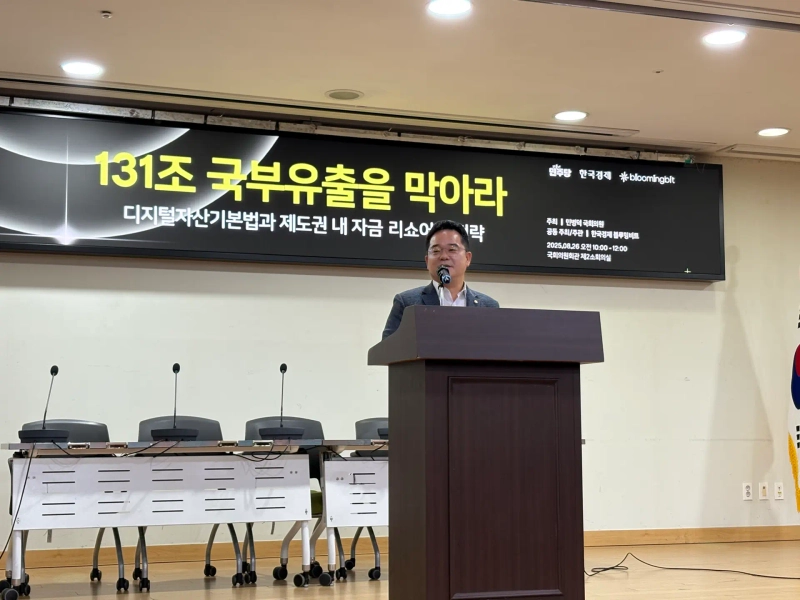
The Democratic Party of Korea has directly opposed the position of the monetary authorities that the issuance of Korean won-based stablecoins should be limited to banks. The party insists that the won stablecoin market should be actively opened to private entities.
On the 26th, Min Byung-deok, a member of the Democratic Party, stated at the seminar 'Preventing the Outflow of ₩131 Trillion in National Wealth: Digital Asset Basic Law and Onshore Fund Strategy within Institutional Frameworks' held at the National Assembly Members' Office Building in Seoul, "Issuing stablecoins centered on banks is a logical contradiction that goes against the decentralization of blockchain." The seminar was jointly hosted by Representative Min and Hankyung Bloomingbit to discuss policies related to the introduction of won stablecoins. Attendees included Representative Min, Kim San-ha, CEO of Bloomingbit, Ryu Hyuk-seon, professor at KAIST, Lee Jong-seop, professor at Seoul National University, and Jo Jae-woo, professor at Hansung University.
"Bank of Korea Should Not Obstruct"
At the seminar, Representative Min pointed out the Bank of Korea's argument regarding the Korean won-based stablecoin. Lee Chang-yong, Governor of the Bank of Korea, recently stated at the National Assembly's Planning and Finance Committee, "(It is) advisable to introduce the Korean won-based stablecoin starting with banks and gradually expand." In response, Representative Min said, "The know-how in managing legacy finance cannot be applied as-is to digital assets," and added, "Bank of Korea should not obstruct (the issuance of won stablecoins) on the grounds that it cannot be managed under the current management system."
He also mentioned examples from competing countries such as Hong Kong. Earlier this month, Hong Kong implemented ordinances containing specific guidelines on stablecoins. Representative Min said, "Recently, I met with a member of Hong Kong's Legislative Council and asked about stablecoin issuers. In Hong Kong, all legally incorporated entities, including banks, can issue stablecoins." He added, "However, in Hong Kong, the primary consideration for licensing is the use case, and coins that do not have any use will not be approved."
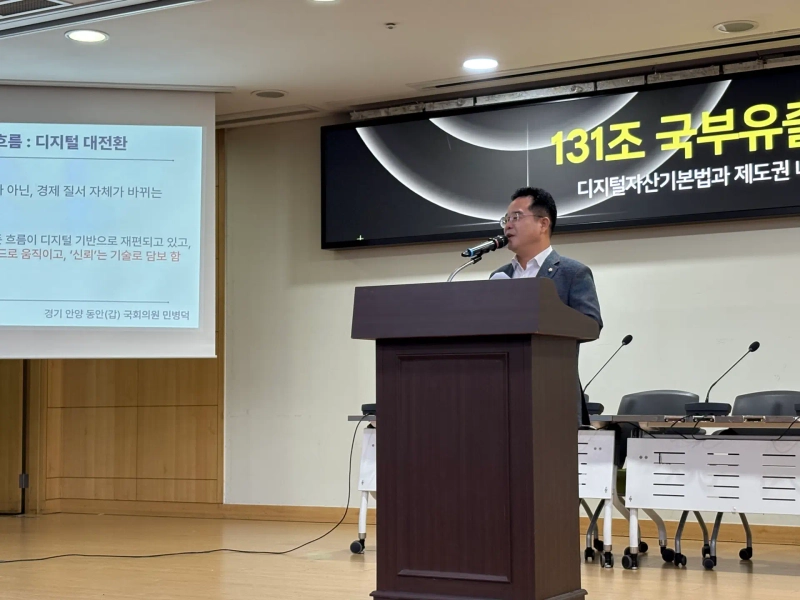
The importance of digital assets was also emphasized. Representative Min stated, "Stablecoins, infrastructure blockchain, and the AI economy are all centered on digital assets. In particular, stablecoins have become the core of digital competition in the realm of monetary and economic sovereignty between countries, beyond being mere means of payment." He added, "The United States is institutionalizing stablecoins to expand the existing dominance of the dollar into the digital realm. Similarly, China is seeking to reshape the US-centered global financial order through the digital yuan and stablecoins. The entire world has now entered a digital war."
'Park Sang-ki Incident' Also Mentioned
He also pointed out the so-called 'Park Sang-ki incident.' The 'Park Sang-ki incident' refers to the episode where former Minister of Justice Park Sang-ki, in 2018, remarked that the government was considering shutting down cryptocurrency exchanges, which caused a sharp drop in cryptocurrency prices. Representative Min stated, "After the Park Sang-ki incident, Korea's outstanding talent and capital left overseas in search of opportunities, leading the Korean digital industry to a crisis of extinction and a loss of competitiveness. Korea still locks (digital assets) under the outdated term 'virtual assets' and shadow regulations."
He also mentioned global competition surrounding digital assets. Representative Min said, "While other countries are expanding their economic territories by issuing stablecoins based on their respective currencies, we are stuck on the fundamental question of 'who and how should issue them?'" He continued, "Competing countries like Hong Kong and Japan have already established national strategies for digital assets and are moving quickly. Enacting the Digital Asset Basic Law to ensure a stable foundation for growth is Korea's survival strategy."

JOON HYOUNG LEE
gilson@bloomingbit.ioCrypto Journalist based in Seoul