

PiCK
"Toward a 'Digital Economy G2'...Min Byung-deok: 'Stablecoins Are a Survival Task for Korea'"
Summary
- Min Byung-deok emphasized that the KRW stablecoin is Korea's survival task and the Digital Asset Basic Act will enhance national competitiveness.
- It was reported that discussions took place on the introduction of the Digital Asset Basic Act and KRW stablecoins to prevent the outflow of domestic digital assets overseas and promote reshoring.
- Experts stressed that the institutionalization of derivatives and credit provision is essential for investor protection, securing domestic liquidity, and preventing the outflow of funds.
Min Byung-deok, Democratic Party lawmaker · Hankyung Bloomingbit
'Digital Asset Basic Act Policy Seminar' Held
Opportunity for South Korea to Leap Forward as Digital Economy G2
KRW Stablecoin, Korea's Survival Task
Digital Asset Basic Act Will Enhance National Competitiveness
Academia Also Calls for Institutionalization of Credit Provision
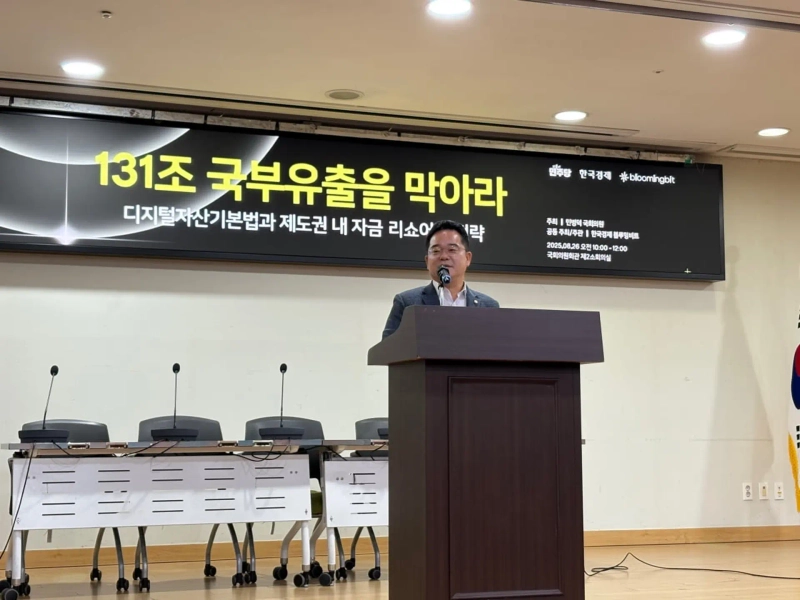
Min Byung-deok, a member of the Democratic Party of Korea, has unveiled a blueprint to elevate South Korea to a digital economy 'G2' through the Digital Asset Basic Act. He particularly emphasized that KRW stablecoins can be a new opportunity for South Korea, which is not a key currency country.
On the 26th, during the keynote speech at the policy seminar titled 'Preventing 131 Trillion Won Capital Outflow: Digital Asset Basic Act and Onshore Capital Reshoring Strategy' held at the Yeouido National Assembly Members' Office Building in Seoul, Min stated, "The digital asset market presents an opportunity to become a G2 without spending budget."
This policy seminar was organized to discuss major issues in the digital asset industry, such as the Digital Asset Basic Act initiated by Min and key agendas including credit provision and the introduction of KRW stablecoins. Notably, with about 131 trillion won in domestic digital assets reportedly flowing overseas due to the regulatory vacuum and other issues, the seminar was held with the aim of correcting this outflow and promoting so-called 'reshoring.'
Min stressed that digital assets are an 'irreversible trend.' He said, "We are currently in an era of digital transformation where not just technological shifts, but the entire economic order is being changed," adding, "All flows in finance, trade, payment, and asset management are being reorganized on a digital basis." He continued, "We are pouring 100 trillion won into developing sovereign artificial intelligence (AI), but digital assets just require a change in the regulatory framework," adding, "especially, the KRW stablecoin and sovereign AI come as a set."
"KRW Stablecoin, Korea's Survival Strategy"
He pointed out that the KRW stablecoin is "Korea's survival task." Min explained, "Stablecoins have become a key element of digital competition in the domains of monetary and economic sovereignty beyond simple payment means," and "the KRW stablecoin is an inevitable survival task for Korea." Furthermore, he said, "While each country is issuing stablecoins based on its own currency to expand its economic territory, we are stuck with the fundamental question of 'who should issue and how,' while competing countries have already established digital asset national strategies and are moving swiftly."
He also countered the position of the Bank of Korea, which insists that KRW stablecoin issuers should be limited to the banking sector. Bank of Korea Governor Lee Chang-yong recently said at the National Assembly Planning and Finance Committee that "(For KRW stablecoins) it is desirable to start with banks and gradually expand." In response, Min commented, "The know-how from managing legacy finance cannot be applied directly to digital assets," emphasizing that "the Bank of Korea should not block the KRW stablecoin simply because it cannot manage it under the current system."
He also mentioned cases from competitors such as Hong Kong. Earlier this month, Hong Kong implemented an ordinance containing specific guidelines for stablecoins. Min said, "I recently met with a member of Hong Kong's Legislative Council and asked about the issuers of stablecoins. According to him, any corporate entity in Hong Kong, including banks, can issue stablecoins." He added, "However, Hong Kong prioritizes usage when approving stablecoins. Coins created with no use case are not permitted."
Min anticipates that the Digital Asset Basic Act he introduced in June will serve as a signal for the growth of the domestic digital asset industry. He emphasized, "If there is a Digital Asset Basic Act, technology and capital will return to South Korea, boosting national competitiveness," and "the Act will be a historic first step essential for South Korea to leap forward as a digital economy G2."

"Calls to Institutionalize Credit Provision"
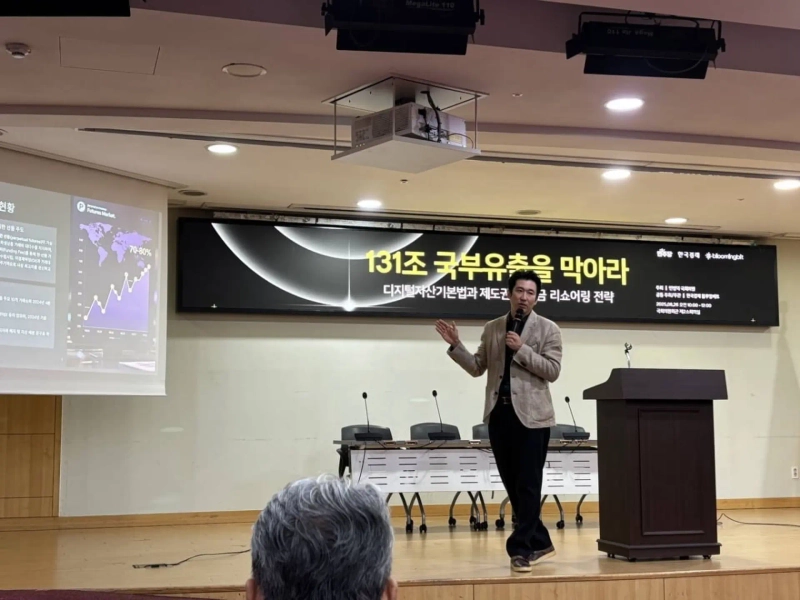
Subsequent presentations included arguments for allowing leverage trading in the domestic virtual asset market. Professor Lee Jong-seop of Seoul National University's Business School said, "Spot investments in the virtual asset market are waning, with the market refocusing on derivatives such as futures. Considering the market size, permitting credit provision is essential."
There were also concerns that, due to the restrictions on leverage trading of virtual assets in Korea, funds continue to flow overseas. Professor Lee said, "As of the end of last year, derivatives accounted for 70-80% of total virtual asset trading volume. Due to restrictions on direct trading of virtual asset derivatives in Korea, the use of overseas exchanges by individuals and corporations has become entrenched." He added, "The persistent offshoring of funds is the result of the lack of competitive derivatives and credit provision instruments in Korea. This has led to issues such as gaps in investor protection, decline in domestic liquidity, and outflow of tax bases overseas."
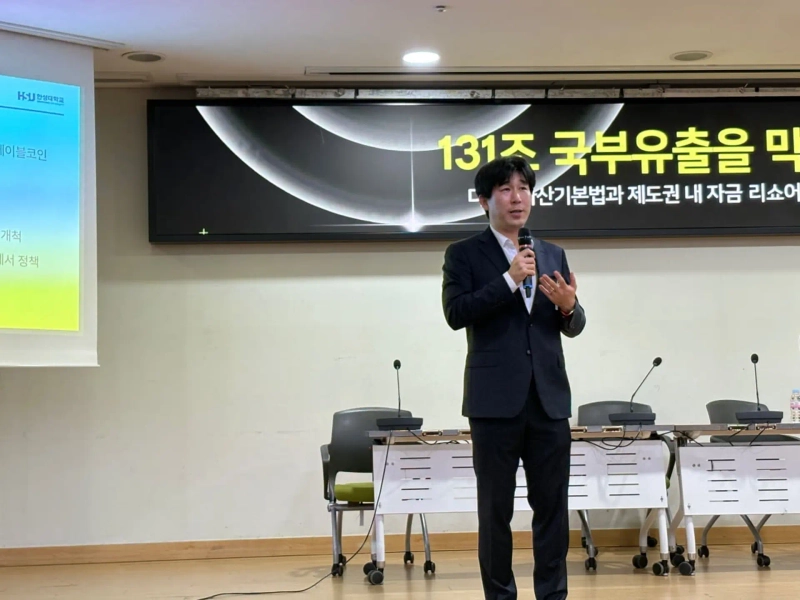
There was also the view that the reshoring (return) of funds that had left the country could be induced through the KRW stablecoin. Professor Jo Jae-woo of Hansung University remarked, "The United States, European Union (EU), Japan, and other major countries have been enhancing their influence in the digital economy for several years through stablecoins based on their own currencies. The longer it takes to institutionalize KRW stablecoins, the more entrenched the market dominance of dollar stablecoins will become, making recovery difficult." He continued, "(Through KRW stablecoins) funds that have flowed abroad as dollar stablecoins can be repatriated as KRW stablecoins, and additional outflows into dollar stablecoins can be prevented."
Professor Jo further emphasized the need to systematize the absorption of reshored funds. He said, "Even though the institutionalization of KRW stablecoins will bring in funds, there is insufficient discussion on how to utilize them," suggesting, "by expanding the supply of short-term government bonds and other safe assets, short-term safe assets should be secured, and policy measures should be prepared to ensure stable fund returns even in the event of rapid redemptions."

JOON HYOUNG LEE
gilson@bloomingbit.ioCrypto Journalist based in Seoul