

PiCK
Virtual assets rebound as US-China avoid direct clash…APEC likely to decide market direction
Summary
- Due to recent escalation in US-China trade tensions, the virtual asset market experienced liquidations of $19 billion and a $400 billion drop in market capitalization.
- Supported by conciliatory messages from President Trump and the Chinese government, Bitcoin and the overall virtual asset market showed a rebound.
- The APEC leaders' meeting in Gyeongju and the decision on whether the 100% tariff will be implemented are expected to be major turning points for the virtual asset market.
Trump shows willingness to negotiate after announcing 100% tariffs on China
$19 billion historic-largest liquidations, rebound within a day
The week of the APEC leaders' meeting in Gyeongju just before the tariff takes effect will be the turning point
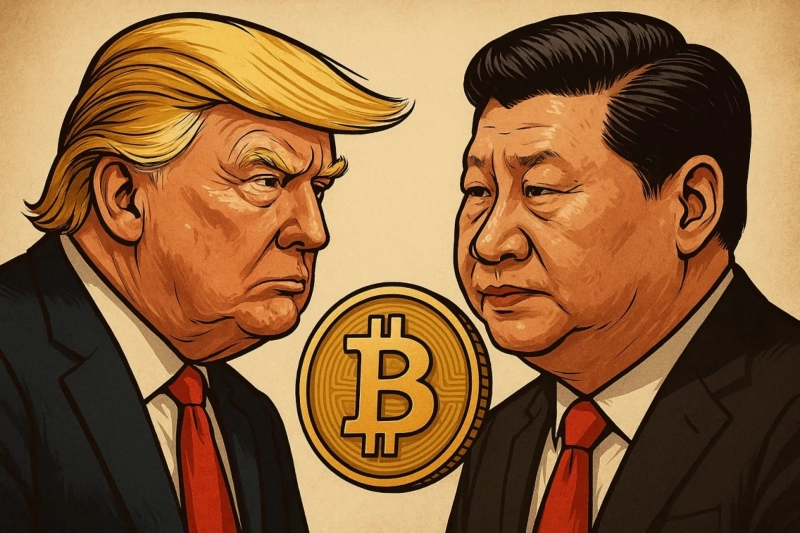
Donald Trump, President of the United States, made remarks indicating a willingness to ease rising trade tensions, and the Chinese government also expressed a desire to resolve the issue through negotiations, leading the virtual assets (cryptocurrency) market, which was hit directly by last weekend's trade conflict, to show signs of recovery. The week of the Asia-Pacific Economic Cooperation (APEC) leaders' meeting held in Gyeongju at the end of October is expected to be a turning point that will determine market direction.
Trade conflict sparked by 'rare earths' leads to record liquidations
On the 9th (local time), according to Reuters and others, China's Ministry of Commerce announced additional export controls on five rare earth elements — holmium, erbium, thulium, europium, and ytterbium. This expands the controlled rare earth elements to 12 out of 17 in total. Since China controls 60% of global rare earth mining and 90% of refining, this measure is likely to have widespread effects across global semiconductors, artificial intelligence (AI), and the defense industry.
Trump struck back immediately on the 10th. He announced he would impose an additional 100% tariff on Chinese imports starting November 1. By applying an additional 100% tariff on top of the existing 55%, he made clear his intention to effectively impose a trade embargo. Trump described China's actions on his Truth Social as "evil and hostile," accusing that "China is holding the world hostage."
As both countries showed no signs of backing down in the trade dispute, markets were shocked. On the 11th, CNN reported that more than 1.6 million investors faced downturn losses due to the conflict, and the crypto futures market saw the largest-ever single-day liquidations of $19 billion.
According to CoinMarketCap data, amid the US-China trade conflict, Bitcoin (BTC) fell from $121,000 to $102,000 — about 16%, Ethereum (ETH) fell 15%, Solana (SOL) fell 16.3%, and XRP (XRP) fell 17.3%. The total market capitalization of the virtual asset market shrank by about $400 billion.
Market surged on US-China reconciliation messages
The mood reversed sharply from the 12th. Through his Truth Social, Donald Trump sent a conciliatory message saying, "Don't worry about China, everything will be fine," and "the United States does not want to hurt China but wants to help." Vice President JD Vance also told Bloomberg in an interview that "the United States has more cards to play but prefers a diplomatic agreement path."
China's Ministry of Commerce also adjusted its response level. According to Al Jazeera, while China criticized Trump's tariffs, it said, "We do not want a tariff war but are not afraid. Differences need to be resolved through negotiations." Both sides indicated a willingness to return to the negotiating table rather than a direct confrontation.
Markets reacted immediately. According to crypto data platform CoinMarketCap, the signals of eased tensions between the two countries pushed Bitcoin up to about $115,000 on the 13th, a 13% rebound from the low. The total market capitalization of virtual assets also recovered to about $3.87 trillion, and the Fear & Greed Index jumped from Extreme Fear (11) to Neutral (55).
Market direction likely set at the Gyeongju APEC
The APEC leaders' week, taking place in Gyeongju, South Korea, from October 27 to November 1, is expected to be the turning point that will determine future market direction. With the planned implementation date of the 100% tariff on November 1 approaching, final discussions between the two countries are likely to take place.
A face-to-face meeting between President Trump and Chinese President Xi Jinping could also take place in Gyeongju. President Trump is expected to arrive in South Korea around October 29 and stay for up to two days. Although Trump said on the 11th that "a meeting with Chairman Xi is not necessary at this time, but I will attend APEC," he softened his stance on the 12th, saying "Chairman Xi does not want his country to fall into a recession. Neither do I," leaving room for negotiation.
Experts expect both sides to reach at least a minimal agreement to avoid a complete collapse of the supply chain. The Center for Strategic and International Studies (CSIS) proposed possible scenarios such as tariff waivers or partial rare earth exemptions. Markets also see a high possibility of an optimistic agreement between the two countries. According to prediction market platform Polymarket, investors estimate the likelihood that the United States and China will reach a trade agreement at about 57%.

YM Lee
20min@bloomingbit.ioCrypto Chatterbox_ tlg@Bloomingbit_YMLEE