

'Debasement trade' Why trading gold, Ethereum, and stocks is drawing attention [Han Sang-chun's Reading of the International Economy]
Summary
- It reported that recent declines in confidence in fiat currency have increased investor preference for assets that possess both real value and monetary function, such as gold, Ethereum, and stocks.
- It stated that if the independence of central banks such as the U.S. Federal Reserve (Fed) continues to be undermined, price stability will become difficult and transactions in alternative assets instead of fiat currency are likely to become more active.
- It reported that in this environment gold is emerging as an investment alternative for inflation hedging and as a safe asset, Ethereum for scalability, and stocks for recent returns.
Confidence in fiat currency falls
Growing preference for investments
that have real value and monetary function
If central bank independence is undermined
price stability will be out of reach
Debasement-trade transactions
may become more active in the future
About a year ago, during the U.S. presidential election process, when the likelihood of then-Republican candidate Donald Trump's victory increased, the 'Trump trade' became popular. Money flowed intensively into Trump-friendly investment targets such as Tesla and Bitcoin. At least until the first half of this year, investment performance was also good.
Recently, 'debasement trade' transactions have been active. This trend refers to a preference for investment targets that have both real value and monetary function as confidence in fiat currency declines. If fiat currency, which has lasted for more than 200 years, disappears, it is expected to bring major changes to central bank monetary policy and the public's monetary life in each country.
The nominal paper fiat currency must not have its credibility in the authority granted by the state undermined in order to perform its functions. The credibility of fiat currency depends on two major conditions. One is exclusive minting authority and the other is price stability. Both conditions are related to central bank independence.
The independence of the U.S. central bank (the Fed), which had been a concern since Trump's first term, has been rapidly eroded in his second term. This is because it has been shaken by changes to monetary policy goals, interest rate alterations, reshuffling of the Federal Open Market Committee (FOMC) members, and unannounced visits to the Fed. Tracking the conflict index between the president and the Fed chair since the Fed's establishment shows that the period of President Trump and Chair Jerome Powell was the highest.
Along with the Miran report, if the scenario of 'Project 2025', the foundation of Trumponomics 2.0, is followed, the Fed will be reduced from an independent institution to a servant of President Trump. It even includes proposals to ultimately abolish it beyond mere reorganization. The plan also calls for decentralizing the central bank's exclusive minting authority through privately issued alternative currencies such as coins.
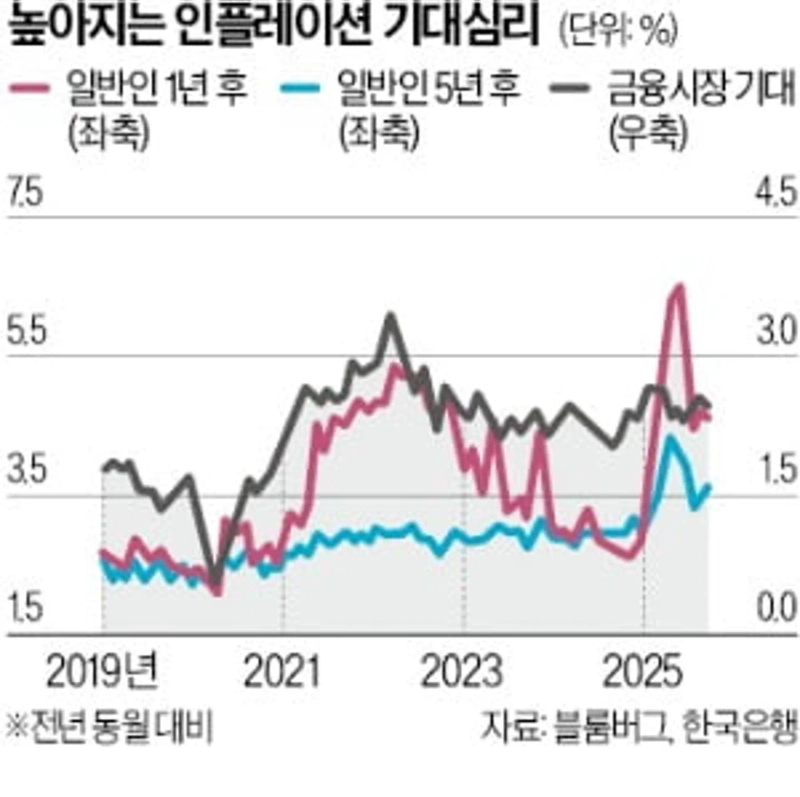
If central bank independence is undermined, the primary goal of price stability will be out of reach. Recently, when the growth rate (g) is higher than the interest rate (r), fiscal spending based on Modern Monetary Theory, which says it is acceptable to borrow and spend more, has become popular. If the central bank cannot play a countervailing role in such times, prices will inevitably rise. If interest rates are lowered as President Trump demands, a phase of 'galloping hyperinflation' in which prices surge could also occur.
If the two major conditions deteriorate and confidence in fiat currency falls, currencies that had been sidelined can rapidly enter the formal system. This is why measures of economic activity such as the velocity of money and the money multiplier have risen recently in an environment where the economy has not recovered. Korea, where the real economy is depressed but stock prices and some real estate prices — such as in Seoul's Gangnam district — have surged, is a representative example.
Gold, which can perform both monetary and inflation-hedging functions, is rapidly emerging as the optimal alternative for debasement trades. The fall in confidence in the dollar and U.S. Treasuries, which has limited the range of safe asset choices, is also a factor driving up gold prices. Debate over a return to the gold standard — restoring the primary currency to gold instead of the dollar — has resurfaced after a long time.
Although not as good as gold, stablecoins are also targets of debasement trades. They are advantageous in terms of value compared to fiat currency, and after the passage of the Genius Act they were officially granted monetary functions. Among coins, Ethereum, symbolic of altcoins, has greater scalability than Bitcoin, whose supply is limited.
Looking only at traditional investment targets such as stocks and bonds, stocks are more favorable. In an era where finance leads the real economy, the inverse relationship between risk assets and safe assets has weakened. This is also why stock returns have exceeded government bond returns in the environment since the Fed began cutting rates in September last year. If the independence of central banks, including the Fed, is not restored, debasement-trade transactions are expected to become more active.

Korea Economic Daily
hankyung@bloomingbit.ioThe Korea Economic Daily Global is a digital media where latest news on Korean companies, industries, and financial markets.