

China's economic growth rate falls to the 4% range…Will the 'Fourth Plenum' find a breakthrough?
Summary
- China's Q3 economic growth rate fell to 4.8%, showing weak domestic consumption and investment.
- The Chinese government plans to focus economic policy at the Fourth Plenum on infrastructure investment in advanced-technology sectors and strengthening technological self-reliance.
- The People's Bank of China held the Loan Prime Rate (LPR) unchanged for October for the fifth month, though year-end monetary easing remains a possibility depending on the need for stimulus.
Trade war increases uncertainty…Q3 GDP grows 4.8%
Retail sales growth at a 10-month low
Infrastructure investment turns negative for the first time in 5 years
Rate cuts cautious despite deflationary pressure
Loan Prime Rate held for five consecutive months
Likely to favor advanced-technology investment over domestic consumption
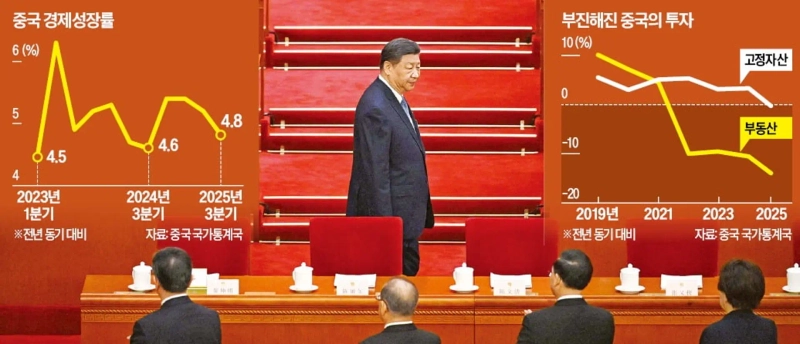
China's economic growth rate for the third quarter fell into the 4% range for the first time in a year. The ongoing trade war with the United States, along with plunging domestic consumption and investment, are contributing factors. As deflationary pressure (falling prices amid economic slowdown) increases, calls for additional stimulus have grown. However, it is reported that at the Fourth Plenary Session of the 20th Central Committee of the Communist Party, which opened on the 20th, China will focus future economic policy more on investment in advanced technologies than on short-term consumption stimulus.
◇ Shrinking retail sales and fixed-asset investment
According to the National Bureau of Statistics, China’s Q3 GDP grew 4.8% year on year, significantly lower than 5.4% in Q1 and 5.2% in Q2. On a quarterly basis it was the worst since Q3 last year (4.6%), showing a growth rate in the 4% range for the first time in a year. However, cumulative growth for Q1–Q3 was 5.2%, exceeding the government’s annual growth target of around 5%.
Alongside the Q3 growth rate, key economic indicators released revealed deepening internal weakness and rising deflationary pressure. Retail sales, an indicator of household consumption spending, are representative. September retail sales in China increased just 3% year on year, the lowest growth rate since November last year. Retail sales have been falling sharply since they recorded 6.4% in May.
Fixed-asset investment has also failed to escape weakness. Cumulative fixed-asset investment for January–September decreased 0.5% compared with the same period last year, marking the first negative figure in about five years since August 2020 at the start of the COVID-19 outbreak. This was worse than the January–August figure (0.5%) and below market expectations (0.1%).
Reflecting the long-running property downturn, real estate development investment for January–September fell 13.9% year on year, and social infrastructure investment grew by only 1.1%. Local governments, facing financial difficulties from the property market slowdown, have been reluctant to invest.
Earlier-released September exports rose 8.3% year on year despite the US-China trade war. Q3 exports totaled $970 billion (about 193 trillion won), the second-best on record. Exports have benefited from rapid regional diversification, but weak domestic consumption and investment have combined to drag down economic growth.
The National Bureau of Statistics said regarding the Q3 slowdown that "the abuse of tariffs by certain countries has affected the global economic and trade order," and that "widespread unilateralism and protectionism have increased instability and uncertainty in international trade growth, complicating the external environment for growth," aiming its remarks at the United States.
◇ Still placing emphasis on advanced-technology investment
Experts say that if domestic demand weakness and the property downturn continue, downside pressure on the Chinese economy will intensify. Reuters compiled economists' views and forecast China’s Q4 growth to slow to 4.3%. In that case, the annual growth rate for this year would be 4.8%, below the government's around-5% target.
Despite the warning signs for China’s economy, the government plans to put more weight on investment in advanced technologies than on boosting consumption. From today until the 23rd, the Communist Party will discuss the 15th Five-Year Plan (2026–2030), which will present a five-year "economic blueprint," at the Fourth Plenary Session. Despite internal and external challenges such as the US-China trade war, weak domestic demand, and the property slump, the upcoming five-year plan is expected to prioritize technological self-reliance to strengthen advanced manufacturing competitiveness and to concentrate on expanding infrastructure investment in advanced industry sectors.
Having reorganized decades-old manufacturing supply chains for the "technology war" era, the strategy in the next five-year plan will focus on addressing already-exposed vulnerabilities in advanced-technology sectors.
The People's Bank of China on the day held the October Loan Prime Rate (LPR) unchanged for the fifth month. The 1-year LPR, the benchmark for general loans, remained at 3% per annum, and the 5-year LPR, the benchmark for mortgage loans, remained at 3.5% per annum. This is interpreted as a stance of caution despite growing downside pressure on the economy.
Some analysts say that if the negative impact of the US-China trade war deepens and domestic demand weakens more rapidly, monetary easing could be introduced toward the end of the year. UOB economist Howei Chen said, "Considering a potential resumption of rate cuts by the US Federal Reserve (Fed) and persistent deflationary pressure within China, the People's Bank of China could cut rates in Q4 this year." Analysts argue that China's leadership could pull out stimulus measures such as monetary easing and property market activation depending on the pace of US rate cuts, the intensity of domestic deflationary pressures, and the results of a US-China summit.
Beijing=Correspondent Kim Eun-jung kej@hankyung.com

Korea Economic Daily
hankyung@bloomingbit.ioThe Korea Economic Daily Global is a digital media where latest news on Korean companies, industries, and financial markets.