

U.S. CME futures outage leaves 26 domestic ETFs in 'dark trading'
Summary
- The Chicago Mercantile Exchange (CME) trading platform paralysis exposed a total of 26 ETFs traded domestically to 'dark trading.'
- With futures price calculation halted, errors occurred in the real-time estimated net asset value (iNAV) calculation, leaving investors unable to know exact asset values.
- There were concerns that liquidity providers (LPs) conservatively priced quotes, which may have caused investors to trade at prices unfavorable compared to the actual value.
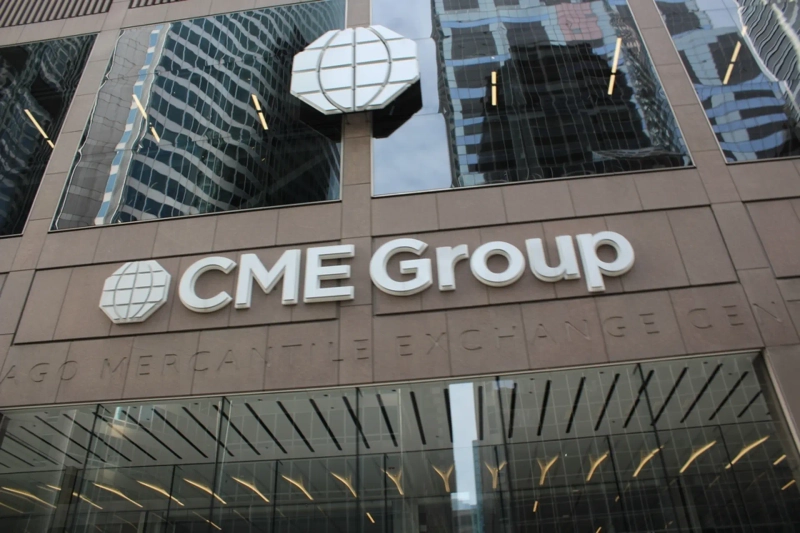
The Chicago Mercantile Exchange (CME) Group's trading platform was paralyzed, exposing some exchange-traded funds (ETFs) traded domestically to 'dark trading.' With futures price calculation halted, investors traded ETFs without being able to know accurate asset prices. There are concerns that liquidity providers (LPs) conservatively priced quotes to avoid losses, which may have caused investors to incur losses.
According to the Korea Exchange on the 28th, asset managers holding CME futures-based ETFs posted an "ETF Other Market Notice" in the afternoon saying, "Since 12:12 p.m., the underlying index feed has not been received, causing errors in the real-time estimated net asset value (iNAV) calculation," and warned that "the divergence between the estimated net asset value and the market price may widen." A total of 26 ETFs made such disclosures. ETFs that use futures traded on the CME as underlying assets — such as S&P 500 futures, gold futures, U.S. Treasury futures, and oil futures — were all affected.
The cause of the problem was a failure of the cooling system at a CME Group data center, which paralyzed the system. Futures trading on the CME for stocks, oil (WTI), gold, copper, and agricultural products was halted, causing the iNAV calculation for ETFs that track those futures prices to stop. iNAV is an indicator that estimates how the actual value of the assets held by an ETF is changing in real time. LPs, who are required to post quotes for ETFs, refer to this to provide appropriate quotes for ETFs. Investors also use iNAV to check whether ETFs are trading at values consistent with their actual worth.
With iNAV calculation halted, CME futures-based ETFs traded without knowing their appropriate prices. Both ETF investors and LPs effectively continued 'dark trading.' An executive at asset manager A said, "In the afternoon, there were temporary cases where LPs did not post quotes, or they posted quotes with wider spreads than usual," and explained, "Because LPs posted quotes based on prices before trading was halted, the divergence did not widen greatly." However, industry sources estimate that in the process of LPs conservatively posting quotes, investors may have bought ETFs at prices higher than their actual value or sold at cheap prices.
Prices of ETFs that are managed based on spot holdings, such as S&P 500 ETFs, were also affected. For ETFs whose underlying assets are overseas, LPs present quotes based on internally calculated appropriate prices that reference futures prices during times when overseas markets are closed. But with futures trading halted, the reference indicators disappeared. An executive at asset manager B said, "Because U.S. markets were thinly traded due to Thanksgiving, the risk of large price swings after the market normalizes is not high," but added, "Only after CME trading is restored can the exact extent of LP and ETF investor losses be determined."
Reporter Suji Na suji@hankyung.com

Korea Economic Daily
hankyung@bloomingbit.ioThe Korea Economic Daily Global is a digital media where latest news on Korean companies, industries, and financial markets.