

Soaring exchange rate sends South Korea's 'dollar GDP' backward this year
Summary
- The IMF said dollar-converted gross domestic product (GDP) is expected to contract this year.
- According to the IMF report, the won·dollar exchange rate is offsetting our country's dollar-denominated GDP gains.
- It said the exchange rate will remain a key variable determining the timing of dollar GDP and per capita GDP milestones going forward.
International Monetary Fund (IMF) report
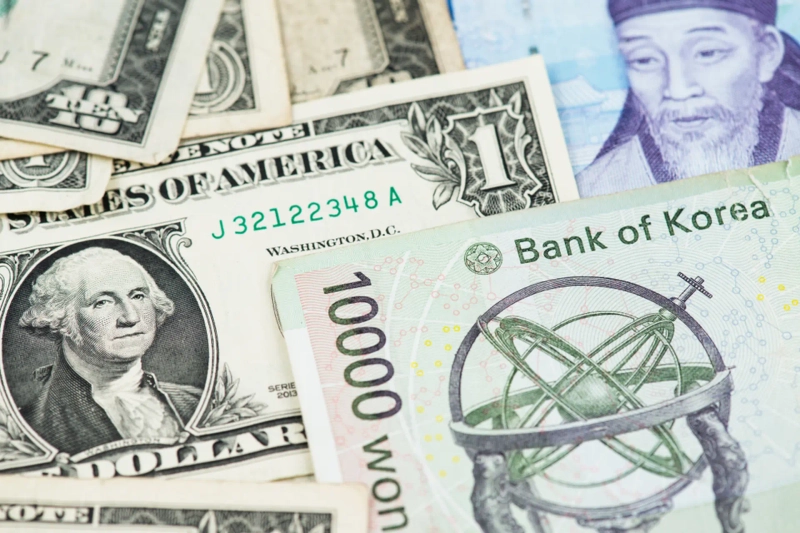
Dollar-converted gross domestic product (GDP) is expected to contract this year. This is the result of the won·dollar exchange rate soaring.
On the 30th, according to the International Monetary Fund (IMF), the IMF estimated in its recent Article IV report that this year's nominal GDP in dollar terms for our country is US$1.8586 trillion. That is US$16.8 billion (0.9%) less than last year's US$1.8754 trillion. Compared with US$1.8448 trillion in 2023, it increased by US$13.8 billion (0.7%) over two years, effectively remaining flat.
The IMF's analysis is that nominal GDP in won terms will rise 2.1% from last year's 2,557 trillion won to 2,611 trillion won this year. This reflects the real economic growth forecast (0.9%) and price factors. The IMF did not present an average exchange rate, but the rise in the won·dollar exchange rate outweighed the GDP increase, so the dollar-converted amount actually fell.
Based on weekly closing prices, this year's January∼November average exchange rate was 1,418 won per dollar, 54 won (4%) higher than last year's annual average (1,364 won). With the exchange rate recently surging to levels that threaten 1,500 won, including December figures could raise the annual average further.
Amid assessments that our country has entered a structurally low-growth phase, the exchange rate is expected to remain a key variable determining the size of dollar GDP going forward. Depending on exchange rate movements, not only the 'US$2 trillion GDP' threshold but also the attainment of a per capita GDP of US$40,000 — which had been expected as early as the year after next — could be delayed.
A high exchange rate in the 'high 1,400 won range' has already become entrenched beyond the policy authorities' scope of response. The Korea·U.S. policy rate differential and excessive market liquidity are pulling down the value of the won, and it is also linked to the recent yen weakness. On the supply-demand side, so-called 'Seohak ants', the National Pension Service's overseas investments, and exporters' withholding of dollar conversion are all acting as factors pushing the exchange rate up.
Song-ryeol Lee, Hankyung.com reporter yisr0203@hankyung.com

Korea Economic Daily
hankyung@bloomingbit.ioThe Korea Economic Daily Global is a digital media where latest news on Korean companies, industries, and financial markets.