

PiCK
Revived yen carry trade liquidation concerns… three major indices close lower
Summary
- Reported that the three major New York indices closed lower as the Bank of Japan hinted at a rate hike, raising concerns about liquidation of yen carry trades.
- The People's Bank of China reaffirmed that stablecoins are illegal, and Bitcoin plunged more than 5%, with cryptocurrencies and related stocks also falling.
- Despite elevated expectations for a rate cut in December in federal funds futures, most sectors fell and investor sentiment worsened.
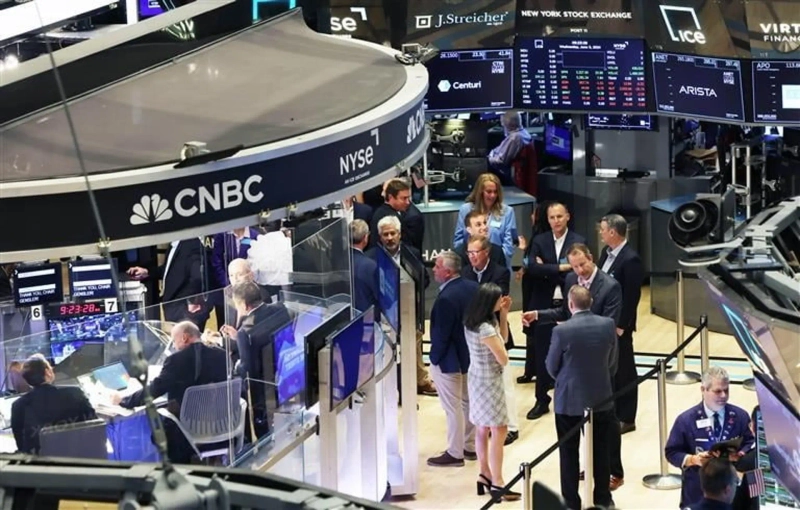
On the first trading day of December, major New York stock indices closed lower. The Bank of Japan (BOJ) signaled a rate increase, and concerns about liquidation of yen carry trades weighed on the stock market, while the People's Bank of China (PBOC) reaffirmed that stablecoins are illegal, pressing down Bitcoin prices.
On the 1st (local time) at the New York Stock Exchange (NYSE), the Dow Jones Industrial Average fell 427.09 points (0.90%) to 47,289.33, the Standard & Poor's (S&P) 500 index fell 36.46 points (0.53%) to 6,812.63, and the Nasdaq Composite fell 89.76 points (0.38%) to 23,275.92.
The central banks of Japan and China worsened investor sentiment in the New York stock market.
Kazuo Ueda, BOJ governor, said, "We will examine the pros and cons of raising the policy rate at the next monetary policy meeting," and, "Adjustments should be neither too late nor too early." The market interpreted these remarks to mean that the BOJ could raise the policy rate this month.
As a result, there were views that some yen carry trades could be liquidated, and U.S. stocks also faced downward pressure.
The People's Bank of China hit the virtual asset market by declaring virtual asset transactions, including stablecoins, "illegal financial activities." On this news, Bitcoin plunged more than 5% that day, and other cryptocurrencies and the stock market were also hit hard.
Because of Bitcoin's sharp drop, Strategy, whose main business is buying Bitcoin, also fell more than 3%. Intraday losses widened to as much as 12.17%.
Despite the year-end shopping season, retailers' stocks remained in a flat range. Walmart rose 0.92%, but Home Depot's gain was only 0.11%. Costco closed slightly lower.
Credit card companies Visa and Mastercard, meanwhile, fell more than 1%.
E-commerce platform service provider Shopify experienced partial outages on Cyber Monday, a peak sales day, causing its stock to fall more than 5%.
Coupang also plunged more than 5% due to a personal data leak.
By sector, all sectors except energy, consumer discretionary, and technology fell.
Utilities plunged 2.35%, and healthcare, industrials, communication services, and real estate fell more than 1%.
Among mega-cap tech companies with market capitalizations over $1 trillion, Nvidia, Apple, and Amazon rose.
According to the CME FedWatch tool, federal funds futures reflected an 87.6% probability of a 25bp rate cut in December.
The Chicago Board Options Exchange (CBOE) Volatility Index (VIX) rose 0.89 points (5.44%) from the previous session to 17.24.
Han Kyung-woo Hankyung.com reporter case@hankyung.com

Korea Economic Daily
hankyung@bloomingbit.ioThe Korea Economic Daily Global is a digital media where latest news on Korean companies, industries, and financial markets.